By: Carter McLellan – Date: September 28, 2024
Contents
- Intro
- Best lawyer in Dallas
- Death of Tom Howard
- Notes
Introductiom
This article, although not much information is currently available regarding the subject, seems the most proper follow up to the latest article discussing the unsolved murder of Dallas Times Herald journalist Jim Koethe.
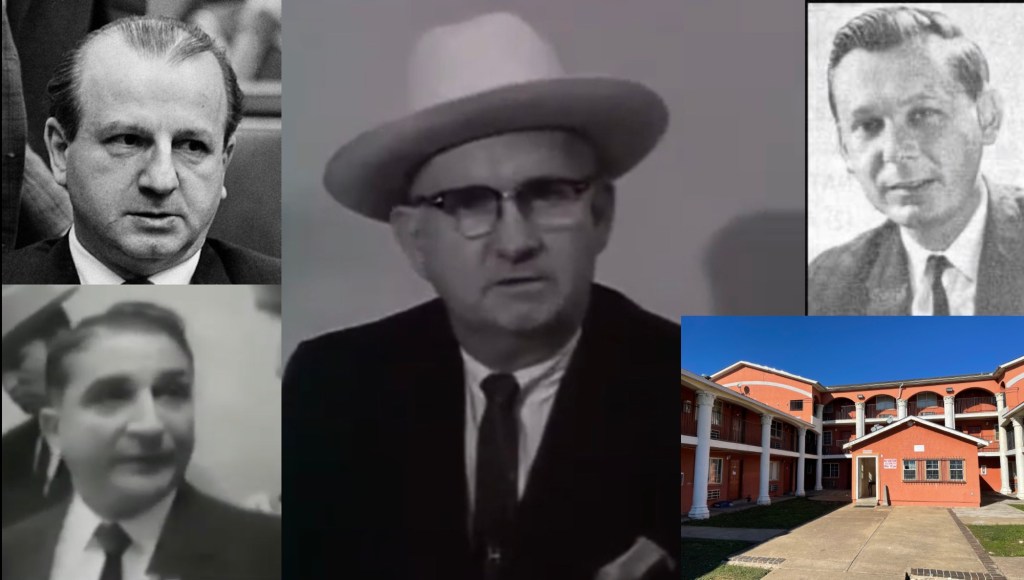
The primary focus of both articles is the November 24, 1963, meeting at Jack Ruby and George Senator’s apartment and those present who had unusual experiences and deaths. There were reportedly up to seven people present that night: George Senator, attorneys Tom Howard, C. A. Droby, Jim Martin, journalists Jim Koethe, Bill Hunter and Willie Allen.
Of these, Hunter and Koethe were murdered in 1964. The latter case in Dallas and remains unsolved to this day, sense the prime suspected was no-billed. Curiously, Jim Martin was a lawyer for the suspect. Tom Howard died in 1965, as you will see, from a heart attack. C. A. Droby and his family received death threats in order to prevent him from becoming Ruby’s lawyer. George Senator was so afraid to stay at the apartment the night of the meeting that he stayed at Jim Martin’s place. As a last note, Willie Allen took the “three tramps” photos, which have been used in conspiracy disinformation for years.
So, three of the seven men were dead within less than two years. One had received death threats and another had been fearful of something. The other two appeared connected to some unusual aspects on the periphery of these cases.
Certainly all do these men had unusual experiences, or were close to some strange events at minimum. For this reason I feel it is necessary in this investigation to examine these men closely.
The best lawyer in Dallas
Thomas Hale Howard was born around 1917, probably in Texas. I practically have zero information on his upbringing. But once he qualified as a lawyer, he settled in Dallas.
Once in 1949, about the age of 32, while in the court of Judge Joe B. Brown, Tom Howard and assistant district attorney Fred Bruner hand a shouting match, in which they attempted to outshoot each other during trial. Judge Brown wasn’t having and had Howard jailed for an hour and a half. Both Judge Joe B. Brown, Sr. and Jr. would later show up in connection with the JFK assassination saga. In 1951, both Howard and Bruner paid $50 fines for the incident.
In 1960, Howard received a six-month suspended sentence and fined $2,500 in Federal Court for failing to file income tax returns for three years. The government also claimed a $22,000 tax deficiency in the suit. Howard was disbarred for six months.
By 1963, Howard became acquainted with local Dallas Times Herald journalists as Jim Koethe and Ben Stevens. By this point, Howard had also done legal work for Jack Ruby, the Carousel Club owner. Lawyers Constine Alfred Droby and Jim Martin, soon to show up in this story, had also known the two journalists and had also done legal work for Ruby.
Howard was a friend of District Attorney Henry Wade, with whom he often opposed, but also often had drinks together after court adjourned. He was said to not only be close to Ruby, but others on the fringes of the Dallas underworld. He had a prominent reputation as the best lawyer or defense attorney in Dallas.
The murder of Oswald
On November 22, 1963, Lee Harvey Oswald fired three shots from the Texas School Book Depository Building at the Presidential motorcade, mortally wounding President Kennedy, injuring Texas Governor Connolly and slightly injuring a bystander named James Tague. He managed to escape the scene, but went on to gun down police office JD Tippit and get arrested.
Immediately rumors abounded as to why And who had really done this. Speculation was not compounded when on November 24, Jack Ruby, the Carousel nightclub owner, fatally shot Oswald at City Hall while he was being transferred. Tom Howard was present at the police station when Ruby shot Oswald. He was able to immediately consult with Ruby after the incident and was spotted by Bill Hunter and Jim Koethe.
Howard and one other attorney were the first to speak to Ruby minutes afterward. Howard and Ruby’s roommate George Senator went to speak with Ruby. Howard would consult with Ruby at the jail frequently in the following days.
After consulting with Ruby after he shot Oswald, Howard made his way to Bill Martin’s TV bar nearby, to wait for George Senator to finish giving testimony to the Dallas Police Homicide of Robbery Bureau. He remained there talking with attorneys Constine Alfred Droby and Jim Martin, when they were approached by journalists Jim Koethe and Bill Hunter. Willie Allen, a journalist, was also reportedly present.
After four of five hours, Senator was finally released around 6PM and he met the group at the TV bar. One of the reporters wanted a photo of Ruby, so they decided to visit Ruby and Senator’s apartment on Eweing to look for one. With help from Droby and Senator this was arranged.
The journalists met Senator and the lawyers at the apartment by around 8PM. Droby recalled that the apartment had been a mess, but had not been ransacked, so he assumed that they had gotten to the apartment before police searched it. Police had actually searched the place already long before at 2PM. Droby observed Koethe make some notes, but it did not appear that he found anything of particular interest. They didn’t find any photos of Ruby. Eventually, the group made their way to Jim Martin’s place for dinner. Droby recalled that Senator was too afraid to stay the night at his apartment, so he stayed at Martin’s. One source claims Howard may not have even been present at the Ruby-Senator apartment meeting.
The trial of Jack Ruby
On November 26, 1963, Howard went to visit Ruby, who hadn’t asked for any lawyer. Senator also wanted Howard to be Ruby’s lawyer. He then became Ruby’s chief attorney and public spokesman. It was Howard came up with the theory that Ruby shot Oswald because he felt sorry for the Kennedy family and wanted to spare Jackie of a trial testimony. Howard believed, and many others, that he would be able to prevent Ruby from getting a charge of murder with malice, and therefore the death sentence. Many believed Howard could have gotten Ruby five years at the most, or a suspended sentence by getting Ruby charged with murder without malice.
David Welsh described Howard’s actions:
“Howard took to the publicity with alacrity, called a press conference, wheeled and dealed. He told newsmen the case was a “once-in-a-lifetime chance” and that “speaking as a private citizen,” he thought Ruby deserved a congressional medal. He told the Houston Post that Ruby had been in the police station Friday night with a gun. He dickered with a national magazine about an Oswald-murder story.”
It was said that Howard had gotten hold of photos of the JFK assassination and attempted to sell them to life magazine. “All told,” Welsh says, “it was never quite clear whether Howard was working for Ruby or against him. … we know he was an irrepressible talker, privy to the intrigues of petty criminality but hardly one to be trusted with any secrets surrounding the Kennedy assassination.”
In these early days, Howard was viewed as colorful and at times a controversial personality. Howard planned to argue that killing Oswald was like “another ****** murder case” and after pleading guilty to murder without malice would get “five years in prison at most”. He told friends that he planned to put Ruby on the stand. Howard had a good reputation as a defense attorney and none of his clients had been executed.
But Ruby became unconvinced of his approach and replaced Howard with Melvin Belli. Howard had sought unsuccessfully to move Ruby’s trial out of Dallas. The trial was held in Judge Joe B. Brown’s court and the prosecutor was DA Henry Wade. During the first few days of Ruby’s trial, Howard showed up to court with Ruby’s other lawyers Melvin Belli, Joe Tonahill and Phil Burleson. Belli and Howard vehemently disagreed over how Ruby should be defended.
Ruby’s brother Earle soured with Howard and had him removed. Ruby’s sister even accused him of leaking information to DA Wade. Howard decided to pull out of Ruby trial when he thought a conviction was inevitable.
Death of Tom Howard
Jack Ruby was convicted of murder with malice and sentenced to the electric chair in March 14, 1964. Howard was the most likely man to head an effort to overturn Ruby’s death sentence in a retrial. It was rumored that Howard had “very important additional information” that he had not given to authorities. What transpired in the following year is not clear to me.
Howard was a known drinker and said to have been diabetic. On March 24, 1965, Howard seemed preoccupied and uncommunicative, and did not appear to recognize friends. The following day, Howard is reportedly observed acting “strangely” by friends. He had attempted to continue his legal practice however.
On Saturday night, March 27, 1965, at the age of 43, Howard suffered a “massive coronary infarction” at the apartment of a girlfriend, Betty Reib, who drove him to Methodist Hospital arriving about an hour later. Thirty minutes later he was pronounced dead and no autopsy was performed.
The death certificate was signed by Dr. Lindsey Elder, who listed the cause of death as “myocardial infarction”, (coronary heart attack) and listed contributing factors as diabetes and a generalized hardening of the arteries.
Rumors of foul play
Much attention has been placed on that Ruby apartment meeting on November 24, 1963. Bill Hunter was murdered by two cops in Long Beach, California, in April 1964. Several months later, Jim Koethe was murdered by strangulation at his apartment in Dallas. The case remains unsolved since the prime suspect was no-billed. The prosecutor in that case was Henry Wade and the suspect’s lawyers included Jim Martin.
George Senator was friends with Martin and stayed the night at his place, too afraid to stay at his own apartment, recalled Constine A. Droby, who himself had received extreme death threats if he became Ruby’s lawyer. Howard ended up dead by heart attack in March 1965. Certainly, it strikes as unusual all these unfortunate incidents occurring to persons involved in the apartment rendezvous.
But Howard’s former law partner, Colley Sullivan, ridiculed any thought of foul play. Sullivan pointed to the fact that Howard appeared ill and complained of chest pains several days preceding the heart attack.
However, “some reporter friends of Howard’s are not so sure.” Welsh describes, “One Dallas reporter says flatly that Howard was bumped off; others are more circumspect. “As far as I’m concerned the case is closed,” one of them says. “You’re not going to catch me messing in that hornet’s nest.””
In the late 1970s, the HSCA had many of the “strange deaths” briefly reviewed and determined that Howard’s heart attack was not of interest, much like that concluded with the car accident of Lee Bowers and others.
Notes
References
- https://isgp-studies.com/death-list-potential-government-assassinations#jfk
- https://isgp-studies.com/misc/death-list/articles/1960s_70s_Jack_Ruby_Tom_Howard_Sam_Giancana_Johnny_Roselli_Jim_Koethe_Bill_Hunter_deaths
- 1993, Bill Sloan, ‘JFK: Breaking the Silence’, pp. 68-80
- ‘Ruby’s First Lawyer, Tom Howard, Dies” – Dallas Morning News, March 29, 1965, p. 3, sec. 4.
- March 30, 1965, Associated Press in New York Times, ‘Tom Howard, Lawyer for Ruby Who Quit in Dispute, Died at 48’
- November 22, 1983, Penn Jones, Jr. for The Rebel, ‘Disappearing Witnesses’
Penn Jones, ‘Forgive My Grief Vol. I’ - 1967, Penn Jones, ‘Forgive My Grief Vol. II’
- HSCA; http://web.archive.org/web/20210211235645/http://mcadams.posc.mu.edu/crs.htm#death8
- Richard Warren Lewis, ‘Scavengers and Critics of the Warren Commission’
- City of Dallas Health Department Office of Vital Statistics
- Spartacus Education: https://spartacus-educational.com/JFKhowardT.htm
- November 1966, David Welsh for Ramparts
- https://www.jfk-assassination.net/death11.htm
- https://www.history-matters.com/archive/jfk/wc/wcvols/wh24/html/WH_Vol24_0228b.htm
- https://time.com/archive/6889699/nation-the-mythmakers/
 Conspiracy Dossiers