Author: Carter McLellan – Date: February 16, 2025 – Updated: November 15, 2025 – Membership Lists
Contents
- Introduction
- History of the Dallas Petroleum Club
- Connections Analysis
- Conclusion
- Notes
Introduction
History of the Dallas Petroleum Club
1934-1940: Early Years at the Baker Hotel
The beginning of the Dallas Petroleum Club dates back to sometime in the year summer of 1934. It was formed in the middle of the “Texas oil boom” period from 1901 1940. It was also during the rough period of the Great Depression, from 1929 to 1939.
Dallas had become the financial center for the oil industry in Texas in 1930- to 1931, after Columbus Marion Joiner discovered the East Texas Oil Field in 1930. The interwar period was a tumultuous time. In 1933, Franklin Delano Roosevelt was elected President, surviving an assassination attempt in Miami, Florida, by Guiseppe Zangara. The period of 1933 to 1934 also saw the plotting and exposure of the “Business Plot”, a very relevant event of intrigue with connections to the south, in opposition to FDR’s ‘New Deal’ liberal reforms. Meanwhile, Adolf Hitler came to power in Germany, becoming Chancellor in 1933. The “Synarchist” plot was allegedly increasing recruiting efforts in France in this period as well.
Multiple organizations sprang up linked to these events, such as the Order of ‘76 in 1932, the Silver Legion in 1933, the Crusaders in the early 1930’s, the Southern Committee to Uphold the Constitution (SCUC) and the American Liberty League (ALL) in 1934, all linked to the Business Plot. A number of clubs were also established during this period and various other NGO’s.
Such were the parapolitical events happening at the time when the Dallas Petroleum Club was formed in 1934. One day in mid-1934, over lunch at the B&B Café in Dallas, possibly at 105 South Akard Street in the Old Imperial Hotel, a meeting took place between three rather mysterious men, known as Wildcatters. They were Carl Young, Russell S. McFarland and Harry S. Moss. All of them were men in the oil and petroleum industry. Together they came up with a plan to establish a private club for oilmen. (1)
Not a whole lot seems to be know about these three men, especially Carl Young, the only detail about whom I have currently is that he was, at the time, the director of standardization for the American Petroleum Institute (API). The API, a trade association representing the oil and natural gas industry, was founded in 1919 and based in New York City and later relocated in 1969 to Washington, D.C. It was linked to the Jim Garrison investigation in 1966 via members of the New Orleans Petroleum Club. It was also linked back in 1921 to the International Chamber of Commerce (ICC). (2) It has accumulated a number of intriguing connections over the decades.
The second individual was Russell Scott McFarland, 1893-1968. At the time in 1934, he was President of Seaboard Oil Co. Not a whole lot of information seems to be currently available regarding this company. McFarland was born in Denver, Colorado, in 1893. After his father died in 1906, the family moved to Missouri, where he went on to attend Park College and the University of Missouri, obtaining a major in geology. He worked for Henry L. Doherty of Empire Gas & Fuel Co. from 1916 to 1918. He served in the Air Corps during WWI for six months, then became a consultant in Cisco, TX, with Orval L. Bruce. He got married in 1917 and moved to Dallas in 1919, where he became a consulting geologist for Robert T. Hill and J. E. Brantley. In 1920, “Russ”, as he was known, joined Twin States Oil Co. (Sun Co.) and moved to Tulsa, Oklahoma. In 1925, he became Vice President of the American Association of Petroleum Geologists (AAPG), becoming President in 1928. He died in 1968 from a heart attack at his home in Dallas. (3)
The third individual involved hear appears to have been Harry Stuart Moss, 1888-1970, an independent oilman. He was born in Ontario Canada, in 1888. At some point early on he moved to the US, served in France for the US Army as an aviator during WWI, then moved to Dallas in 1925 and eventually naturalized. He was the President of Moss Petroleum Co., at some point was the director at First National Bank and Texas Mid-Continent Oil and Gas Association. He served as director of the Texas State Fair, served as a life member on the board of the Children’s Medical Center, served as Chair of Salvation Army and was a member of the American Petroleum Institute. He died in late 1970 at his home in Dallas. (4) He appears to have had a pretty significant impact in the Dallas area, with Harry S. Moss Park, among other things, named after him.
Update: Membership lists have been obtained from the SMU DeGolyer library for years 1936-1939, meaning only the first year is missing. This section will be greatly expanded in the future.
First members
Young, McFarland and Moss agreed on a plan of action and formed a committee. They then decided to invite the first members, Jack Pew, executive of Sun Oil Co. and R.B. Whitehead, chief geologist for Atlantic Refining Co. On July 25, Whitehead, as Chairman of the Dallas Wildcat Committee, called together a meeting to outline a plan for a petroleum club. A list of possible members was submitted on August 3, and a location was discussed on August 6. On October 4, the Wildcats sent invitations to eligible prospects, sixty-seven paid initiation fees. On October 18 organization plans were finalized and the steering committee was authorized to sign an agreement with the Baker Hotel to construct club quarters in the grill adjacent to Peacock Terrace at a rental fee of $6000. According to D Magazine, “Club membership was limited to 100 oilmen, each of whom were charged a $100 initiation fee.” (5)

The club was then first established at the Baker Hotel on Commerce Street and South Akard Street. The first annual dinner marking the launch of the Dallas Petroleum Club was held on February 9, 1935, and reportedly attended by about 850 people. The Baker Hotel was opened in 1925 by T. B. Baker of Baker Hotel Company (6)
Little information seems to be available as to who the first 100 members of the DPC were, or who attended its earliest annual dinners. But we do have the first two members brought in by the founding committee. Update: The first board included D.A. Little, Jack Pew,
Harry Bass, J.F. Lucey, Harry Morlang, C.A. Young, R.S. McFarland, R.H. Morrison, D. Harold Byrd, H.S. Moss, W.H. Francis and R.B. Whitehead. Directors named Little President, McFarland Vice President, Whitehead Vice President and Morlang Secretary-Treasurer. By-laws were drawn by W.H. Francis. L.T. Foster and Woodall Rodgers prepared papers of incorporation and made an application for a charter. Rodgers stated:
‘The purpose for which the Club was formed is: The support and maintenance of an educational undertaking for the improvement and development of the human mind, through reading, discussion, exchange of ideas, lectures, information, social contacts and all other means that will contribute to such educational improvement and development of the members of the Club.’
One of the two first men invited was R. B. Whitehead, chief geologist for Atlantic Refining, Co. Not much seems to be known about Whitehead, but Atlantic Refining had been acquired by Standard Oil of the Rockefeller family in 1874. It split in 1890 after the Sherman Antitrust Act. Much later it would be acquired by Sunoco in 1988. (7)
Jack Pew, the second invited member, is actually a fascinating name to come up, but also one that seems to be little known. John G. “Jack” Pew was an executive of Sun Oil Company. This is very likely to same Sun Co. subsidiary linked to Russ McFarland. Jack was born around 1902 and went on to serve as President of several Sun Co. subsidiaries. He served on the board of directors of Sun Co. from 1941 to 1975, and succeeded his father as vice president in charge of production in 1946. During his life he held top positions in a number of trade groups, including the American Petroleum Institute and the International Oil and Gas Educational Center. He also served as the director of Boys Clubs of America and received the first Boys Club Freedom Award in 1975. He died in 1982 at his home in Dallas. (8) Today Sunoco is based out of Dallas.
Jack Pew is probably one of the most intriguing early names to come up in the Dallas Petroleum Club. The Sun Oil Co. of Pittsburgh, Pennsylvania, was founded and ran by the Pew family, which featured prominently in the previously mentioned Business Plot, specifically through J. Howard Pew. This is a family that has been linked to domestic sponsorship of fascism. (9)
The Peoples Natural Gas Company was formed in the 1800s, in Pittsburgh, PA, as a partnership between Joseph Newton Pew, Philip Pisano and Edward O. Emerson. From 1886 to 1920, it was known as Sun Company, Inc., from 1920 to 1976 as Sun Oil Co. and again as Sun Company from 1976 to 1998. This is where Sunoco gets its name. It expanded from PA into Ohio. In 1901, it was incorporated in New Jersey. In 1902, Sun Oil Refining Company was chartered in Texas, turning its interest toward the Spindletop field. Joseph Newton Pew’s nephew, J. Edgar Pew, was able to buy the storage and transportation assets of Lone Star and Crescent Oil Company at a receivership auction. Joseph N. Pew died in 1912, after which J. Howard Pew and Joseph N. Pew, Jr. took over the company. It became a publicly traded company in the NY Stock Exchange in 1925. It continued to grow and expand over the decades. (10)
J. Howard Pew was a member and financier of the American Liberty League (ALL), which was founded in 1934 and shutdown in 1940. The League included a swath of elite characters, including Al Smith, John W. Davis, Irenee du Pont, Grayson M. P. Murphy, Robert S. Clark, Alfred P. Sloan, Jr., Elihu Root, John J. Raskob, Thomas W. Lamont, J.P. Morgan men. Contributors included the Pew, Pitcairn, Rockefeller and Mellon families. ALL funded the Southern Committee to Uphold the Constitution and the Sentinels of the Republic, from 1934 to 1936. (11)
J. Howard Pew was also a members and major financier of the Sentinels of the Republican alongside the Pitcairn and du Pont families. The Sentinels were founded in 1922 to opposed what it saw as federal encroachment on the rights of the States and of the individual. It worked against child labor laws and the new deal. In 1926, in a fund-raising pamphlet entitled “To Arms! To Arms!”, the organization boasted that it had “card-indexed more than 2000 radical propagandists making it comparatively easy to check their movements and counteract their activities.” Members labeled FDR’s New Deal as “Jewish Communism” and insisted old line of Americans who wanted $1,200 a year wanted a Hitler. It disbanded in 1944 following a decline in its support base. (12)
J. Howard Pew co-founded the Pew Charitable Trusts in 1948, which today makes donations the left wing causes. Furthermore, he was a longtime friend and supporter of Robert Welch, founder of the John Birch Society in 1958. He once donated to the Neo-Nazi Liberty Lobby, which was founded in 1958. He was a supporter of Barry Goldwater in 1964. He donated to the libertarian Foundation for Economic Education and was a member of the Mont Pelerin Society. He died in 1971, in Pennsylvania. (13)
1940-1952: Adolphus Hotel Era

Around the start of WWII, the Dallas Petroleum Club relocated across the street to the Adolphus Hotel, on 1321 Commerce Street, leasing a paneled lounge and dining room on the ground floor. (14)
The Adolphus Hotel was constructed in 1911 by Adolphus Busch, founder of Anheuser-Busch, and opened in 1912. Busch was the owner of the Oriental Hotel across the street and was approached by a group of prominent Dallas businessmen in 1910 with the idea of constructing the first European-style luxury hotel in the city. Busch purchased Dallas’s old City Hall on June 22, 1910, demolished it and constructed the new hotel, originally naming it the New Oriental Hotel. The name was changed to the Adolphus Hotel by the opening and in 1912. It was the tallest building in Dallas for ten years. During the 1930’s it was run by the National Hotel Management Company and hosted many big band musicians of the era. Over the decades it has hosted many respected leaders of business, government and entertainment, including presidents, including President Warren G. Harding. It has also been regarded as a Dallas hub for entertainment and business. (15)
It is hard to say how many members the DPC had during this period, or who joined them between 1940 to 1952. I just simply don’t have any definitive historic sources yet. But it is fairly certain that the founders and earliest members continued to participate in the club through this period at the Adolphus.
Update: Membership lists have been obtained from the SMU DeGolyer Library for the years 1940, 1944-1949, 1951-1952. Only missing lists from this period are from 1941-1943, and 1950.
1952-1965: Back at Baker
The Baker Hotel across the street from the Adolphus had an addition made in 1950. Sometime in 1952, the Dallas Petroleum Club moved back somewhere in the Baker Hotel. (16) It is around this period that we get some additions to the membership list.
It is reported that in May 1953, Senator Joseph McCarthy accompanied Clint Murchison, Sr. to a speech at the Dallas Petroleum Club. (17) It was likely during this period back at the Baker Hotel, that Dallas Petroleum Club member Paul M. Raigorodksy invited George De Mohrenschildt to the club. De Mohrenschildt had moved to Dallas in 1952, where he established himself as a consulting geologist working for Clint Murchison. (18) These four additions to our membership list are fascinating.
A story by TIME has Clint Murchison, Sr., as a member of the Dallas Petroleum dating back to 1947, during the Adolphus Hotel era. (19) It is unclear when exactly Murchison became a member of the club, but certainly possible he joined by its founding in 1934.
What we know is that he got his start with his closest lifelong friend Sid W. Richardson, in 1919, as a lease trader at the Burkburnett oilfield. He got into exploration and development selling his holdings for $5 million in 1925 and moving his base to San Antonio. (20)
He moved into an apartment at Maple Terrace, in Dallas, by late 1928. In January 1929, Murchison leased space in the American Exchange Building in Dallas, where he consolidated his gas business, creating Southern Union Gas Company, which supplied natural gas to Texas, Oklahoma, Arkansas and New Mexico. (21)
Clint Murchison, Sr. was born on April 11, 1895, to financier John Weldon and Clara Lee Williams Murchison in Tyler, Texas. He went to Trinity College, but quit and went to work at his father’s bank, in 1915. He soon quit the job to to serve in US Army during WWI. (22) He returned in 1919, when Sid Richardson got him into the oil business.
He got married in 1920, to Anna Morris, a girl from Tyler. They had three sons, John D. Murchison, in 1921, Clint Murchison, Jr., in 1923, and Burk Murchison, in 1925. His wife Anna tragically died from an illness after a trip in 1926. He was said to have spent a whole year drinking and traveling, before refocusing on his business, moving from San Antonio to Dallas by 1929 to establish Southern Union Gas Co. (23)
In 1930, Murchison became one of the earliest developers in the East Texas oil field, acquitting extensive leases and building the Tyler Pipe Line to deliver crude oil to a new refinery in Tyler. Underscoring his political opinions, he named a new corporation the American Liberty Oil Company to express his opposition to government regulation on the industry. (24)
In the early 1930’s, he became involved in a fierce battle over oil proration. He was interested in defending and upholding the private enterprise system particularly for the oil and gas industry. Other political interests included farm legislation, a federal land bank, the milk system, international trade, the gold system and the fight against Communism. Even during the inter-war period, Murchison was worried about the Communist threat in Russia. (25)
It’s very possible that Clint Murchison, Sr., was one of the first men invited to the Dallas Petroleum Club in 1934. He’d already consolidated his business in Dallas by 1928 and had become a prominent player in the field.
His youngest son Burk Yarbrough Murchison died at the age of 11, in 1936. (26) Clint Sr. began to diversify his assets in the late 1930’s. During WWII, in 1943, he married Virginia Long, of Commerce, Texas. (27)
In 1945, Clint formed Delhi Oil Corporation, which became one of the largest integrated independent oil companies in the country. Delhi’s Canadian subsidiary developed gas reserves in Western Canada leading Murchison to build the 2,100-mile Trans-Canada Pipe Lines completed in 1958. (28) Clint also began to frequent correspond with Lyndon Baines Johnson, in 1945.
It was after WWII, that Clint Murchison, Jr. joined his brother John D Murchison in the family business of their father. They would help diverted their assets, acquired life insurance companies, banks, bus lines, railroads, publishing firms, heavy industrial building materials companies and other leisure-themed companies. Holdings reportedly included New York Central Railroad, Daisy Manufacturing Company, Lionel Trains, Henry Holt Publishing, Field & Steam magazine, Heddon Rod & Reel, and Allegheny Corporation. (29)
Certainly by 1947, Clint Murchison, Sr., was a member of the Dallas Petroleum Club. Sense the club has often been a family affair, it’s very likely that his two sons became involved in early on in their twenties with the club. Murchison Brothers was started in the late 1940’s, in Dallas. (30)
It also appears that Murchison, between 1944 and 1947, had been a financier of Dr. Alton Ochsner in Louisiana. Edward Haslam explains:
“… he was a personal patient of Alton Ochsner and gave him a Cadillac as a “thank you” present, but he also donated $7564 – 17964 – 1770,000 to the Alton Ochsner Medical Foundation as seed money for Ochsner’s new hospital.”
The Ochsner Clinic was founded in 1942, followed by the Alton Ochsner Medical Foundation two years later. The Murchison family appears to have been a major financier of the Ochsner Foundation Hospital. (31)
In 1948, Murchison was reportedly spotted with LBJ after a controversial election, and visited by J. Edgar Hoover of the FBI. Murchison had helped Johnson win an election in East Texas. (32)
Murchison came to own several ranches. In 1950, he hosted the Duke and Duchess of Windsor at a ranch near Tampico, Mexico. (33) Together with Sid Richardson, Murchison opened the Hotel del Charro, in La Jolla, California, in 1951. (34) A number of key developments took place the following year. Murchison and Richardson had lobbied to get Dwight Eisenhower to run for President as a Republican, despite them being Democrats. They had backed General Douglas MacArthur for President in 1952, but he was unsuccessful. MacArthur’s name came up back in 1934 during the Business Plot. (35) It was in 1952, that J. Edgar Hoover and his aide Clyde Tolson first visited the Hotel del Charro at Murchison’s invitation. Hoover would return every year until his death in 1972. (36)
Numerous politicians visited Hotel del Charro, including Eisenhower in 1952. Another visited was Senator Joseph McCarthy, who came in August 1952. McCarthy was the man behind the “Red Scare” of the 1950’s. In May 1953, McCarthy accompanied Murchison’s Mexican ranch, before visiting the the Dallas Petroleum Club for a speech. Murchison, and many other oilmen including his son Clint Jr., supported McCarthy, but he reportedly was kicked out of Del Charro in 1954 and a split occurred when he went after the Army and caused a conflict with Eisenhower. McCarthy died suddenly in 1957. (37) McCarthy is of particular interest because of his lawyer at the time, Roy Cohn.
In 1955, Murchison’s Delhi merged with Taylor Oil and Gas Co. to form Delhi-Taylor Corporation. Murchison also acquired holdings in the Kirby Petroleum Company. In 1960, he backed Richard Nixon for President and had supported LBJ. (38) Clint Murchison’s closest friend, Sid Richardson, died in 1959. It was in 1960 that Clint Murchison, Jr. founded the Dallas Cowboys football team, which he owned until 1984. (39)
In 1961, Murchison financially backed the founding of Alton Ochsner’s Information Council of the Americas (INCA), in New Orleans. Curiously, also that year, Murchison sold a Beverly Hills estate to Nixon for $35,000, a property he financed through a loan from Jimmy Hoffa. Furthermore, at one point, almost 20% of Murchison Oil Lease Company in Oklahoma was owned by Gerardo Catena, a chief of the Genovese family. (39)
Update: Membership lists obtained from the SMU DeGolyer Library include years 1952 to 1956. Missing years from this point forward for this section.
The JFK assassination
There were two members of the Dallas Petroleum Club, during this period at the Baker Hotel, who testified in 1964 before the Warren Commission: Paul M. Raigorodsky and George S. de Mohrenschildt.
Both men were part of the White Russian Emigre community in Dallas. De Mohrenschildt specifically was in direct contact with Lee Harvey Oswald, the man accused of killing the President, between 1962 and 1963. A number of the connections of the Murchisons can also be linked back to Oswald.
Although Raigorodsky denied knowing Oswald before the assassination, he was the one who invited de Mohrenschildt to the Dallas Petroleum Club, probably around 1952. (40) Raigorodsky was born in 1899, in Russia. In 1919, he fled Russia, going to Czechoslovakia, then fought against the Bolsheviks. In 1920, he moved to the USA and served two years in the US Army Air Corps. From 1922 to 1924, he attended the University of Texas, specializing in petroleum engineering. He got married that year to Ethen McCaleb, whose father had been head of the Federal Reserve Bank of Dallas, then moved to Los Angeles, California. He worked at E. Forrest Gilmore Co., Newton Process Manufacturing Co. and Signal Oil and Gas Co. (41)
In 1928, he helped found Engineering Research and Equipment Co., then went to Dallas, Texas, to organize an office there. He also traveled to Tulsa, Oklahoma, and Louisiana, on business. In 1929, he sold his third in Engineering Research, and founded Petroleum Engineering Co., in Houston, Texas. In 1941, he was called to go to Washington, D.C., to help organize the Department of Natural Gas and Natural Gasoline Industries. He eventually resigned in 1943, after suffering from an ulcer and returned his business in Houston. His wife divorced him that year as well. In 1949 to 1950, having suffered from neck problems, he moved to Dallas. In 1952, he was called by Deputy Ambassador Anderson, to come to Europe to help NATO countries with production of tanks, planes, ammunition, and other things. He eventually returned to Dallas after suffering from neck problems. (42)
At some point between 1947 to 1950, Raigorodksy had been introduced by Jake Hamon [Update: Turns out Hamon was on the board of directors of the Dallas Petroleum Club since 1937, and President in 1944] to George de Mohrenschildt, who moved to Dallas in 1952, and apparently started working for Clint Murchison. It was Raigorodsky who invited de Mohrenschildt, a petroleum geologist and fellow white Russian, to the Dallas Petroleum Club, which Raigorodsky had presumably joined between 1950-1952. Raigorodksy had also been a leader in Dallas of the St. Nicholas Russian Orthodox Church and, in 1954, helped the St. Seraphim Greek Orthodox church get a loan from First National Bank to get set up in Dallas. (43)
Some highly curious connections of Raigorodsky appears in the 1962-1963 period. Raigorodsky was on the board of a cystic fibrosis charity set up by de Mohrenschildt in 1962. Also on the board was the wife of D. Harold Byrd, and Jacqueline Kennedy was honorary chair. (44) Since 1962, de Mohrenschildt had been working on a hemp plantation deal in Haiti with Duvalier. He tried to get Raigorodsky to join, but he recommended their mutual friend Jean de Menil, who also didn’t want to participate. (45) Both Raigorodsky and de Menil were allegedly on the board of the highly curious outfit called Permindex/CMC, of which Clay Shaw also involved. Furthermore, de Menil was part of the Schlumberger business, the same one that owned the Houma arms depo that was raided by Guy Banister, David Ferrie, Sergio Arcacha Smith and Gordon Novel. (46)
George de Mohrenschildt was born in April 1911, in Mozyr, Russian Empire (today Belarus). In 1920, his father Sergey, reportedly a Marshal of Nobility, was arrested for allege anti-Soviet agitation and sentenced to life exile. Sergey fell ill, when two doctors helped him escape Russia with his family to Poland. During the trip they had contracted an illness, resulting in his mother’s death. George’s brother Dimitri, who was awaiting execution, was sent to Poland as part of a prison exchange. They settled in Milno, where they owned some property. (47)
George graduated from the Wilno Gymnasium in 1929, and from the Polish Army’s Cavalry Academy in 1931, later earning a Master’s degree at the Institute of Higher Commercial Studies. He went to Belgium, where he earned a PhD of science in international commerce at the University of Liege, in 1938. He made a change to his name and moved to the United States, staying with his brother in Long Island, New York. HE reportedly gathered information about pro-Nazi activities and helped French companies outbid the Germans on oil leases. His brother Dimitri has worked with the OSS. Interestingly, George became acquainted with the Bouvier family, even meeting a young Jacqueline, who referred to him as “Uncle George.” (48)
From 1939 to 1941, George tried getting into the insurance business. He also got involved with Film Facts in New York, a production company owned by a cousin, Berend Maydell. A CIA document named George as a Nazi espionage agent, but George strongly denied such allegations. He was married to Dorothy Pierson from 1942 to 1944, having a daughter. In 1945, he obtained a master’s degree in petroleum geology from the University of Texas. (49)
After WWII, in 1946, George moved to Venezuela where he found work in the oil business, working for Hampton Industries Oil. He was married to Phyllis Washington, daughter of a diplomat, from 1947 to 1949, the year he became a naturalized US citizen. At some point in this period, George had been working at the Rangley Field in Colorado, when Jake Hamon introduced him to Paul Raigorodsky at the Brook Hollow Golf Club. (50) In 1950, George and a step-nephew, Edward Hooker, set up an oil investment firm with offices in New York City, Denver and Abilene. George was married to Wynne “Didi” Sharples, from 1951 to 1956. Together they had a son and daughter who both suffered from cystic fibrosis. (51)
George moved to Dallas in 1952, meeting up with his good friend and fellow White Russian emigre, Paul Raigorodsky, and reportedly getting a job as a consult working for Clint Murchison, Sr. At some point, Raigorodsky invited George to join the Dallas Petroleum Club, putting him in contact with the top oilmen in Dallas. He also joined the World Affairs Council of Dallas/Fort Worth and taught at a local college. In 1957, George went to Yugoslavia to conduct a geological field survey for the State Department-sponsored International Cooperation Administration. He was accused of making drawings of military fortifications and upon his return to the US, he was debriefed by the CIA in Washington and Dallas by J. Walton Moore. (52)
George was married to Jeane LeGon, a former dancer, model and fellow Russian-American whose father was Director of the Chinese Far East Railway and killed by communists, from 1959 to 1973. From 1960 to 1961, George and Jeane went on a “walking trip” tour of Central America, following the death of his son in 1960. He returned to Dallas in 1961, remaining through through 1962 and intro 1963. (53)
Lee Harvey Oswald and Marina Oswald, arrived in the US from the Soviet Union with their daughter in June 1962. They settled in Fort Worth with Oswald’s brother Robert. Oswald had brought a memoir from Russia and met Peter Gregory at the Fort Worth Public Library. Gregory made his presence known to the White Russian émigré community. In July, Oswald had gotten a job at the Leslie Welding Company in Dallas, eventually getting an apartment in August at 2703 Mercedes Street. During this period he had been contacted for interviews by the FBI. He’d been frequently meeting with the Russian emigre community and was invited by Gregory to a dinner with them, where he met George Bouhe. In mid-September, Bouhe informed de Mohrenschildt about Oswald, so he visited the Oswald at their apartment in Fort Worth. (54)
Oswald quit/fired his job at Leslie, so Marina moved in with the Hall family. De Mohrenschildt and Bouhe helped Oswald to eventually get a job at Jaggar-Chiles-Stovall, as a photoprint trainee, in October 1962. This allowed him to get an apartment at 604 Elsbeth Street, in south Dallas. There Oswald and Marina had a contentious relationship, at one point George had to step in to help in the situation. George invited the Oswalds to a party in December 1962. That year, George began working on a business deal in Haiti. In January 1963, Oswald got an apartment at 214 West Neeley Street. On February 22, 1963, George invited the Oswald to a party, where they met Ruth Paine, who became a close friend of Marina. In April, 1963, Oswald sent a photo of himself holding a rifle and communist magazines, calling himself a “hunter of fascists.” On April 10, Oswald attempted to assassinate Edwin Walker. On April 15, George and Jeanne visited the Oswald’s at their Neeley Street home. While there, Jeanne discovered Oswald’s Carcano rifle in a closet, prompting George to remark, “Were you the one who took a pot-shot at General Walker?” Allegedly, George had contacted the CIA with regard to Oswald being a suspect in the Walker shooting, but this was the last time George saw Oswald. In May or June, 1963, George and Jeane moved to Haiti, where he had a business deal. (55)
I rather bizarre allegation was made by Gerald P. Hemming, who claimed that on June 5, 1963, he had been present at the Dallas Petroleum Club with De Mohrenschildt, when he was approached by an unidentified man who proposed assassinating JFK. Hemming claims Nelson Bunker Hunt was present and others were nearby, but he declined the offer. (56) It’s hard to judge the credibility of that claim.
In part of the summer of 1963, Murchison reportedly hung out with John McCloy, who would later become a member of the Warren Commission, following the JFK assassination. (57)
In 1992, a woman named Madeleine Brown alleged that she had witnessed a meeting at a Dallas property of Clint Murchison, on November 21, 1963. She alleged that a meeting took place there between J. Edgar Hoover, Clyde Tolson, John J. McCloy, Richard Nixon, H.L. Hunt, LBJ, and Harvey Bright. She claims LBJ said to her after the meeting, “After tomorrow those goddamn Kennedys will never embarrass me again – that’s no threat – that’s a promise.” Although most of these men can be linked to Murchison, the story has been heavily discredited, and therefore is considered unreliable. (58)
The assassination of JFK took place on November 22, 1963, in Dallas. In 1964, both Paul M. Raigorodsky and George de Mohrenschildt gave important testimony to the Warren Commission. (59) It’s not exactly clear what happened at the Dallas Petroleum Club within the following couple of years after the assassination, or how the members reacted. In any case, the club came up twice in the Warren Commission investigation. And since 1963 and on, a series of ‘strange deaths‘ would occur in an around Dallas.
1965-1986: The First National Banker Tower Years
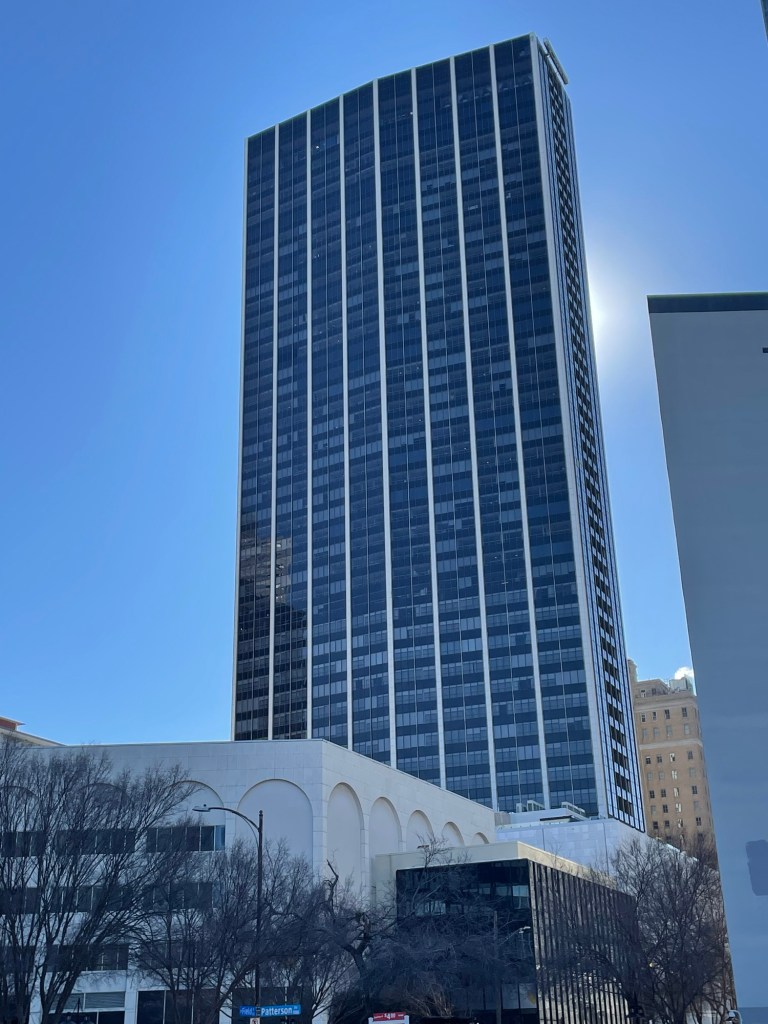
Beginning in 1961, construction began for the First National Bank Tower, at 1401 Elm Street, Dallas, after the demolition of the First National’s motor bank. The construction was jointly handled by Robert E. McKee, Inc., Henry C. Beck Co., and PPG Industries, Inc., designed by George Dahl and Thomas E. Stanley, as well as Harrell & Hamilton. The building was completed in 1965, becoming the tallest west of the Mississippi River until 1969, the tallest in Texas until 1971, and the tallest in Dallas until 1974, with the completion of the nearby Renaissance Tower. (60)
The Dallas Petroleum Club moved into the 48th and 49th floors at First National Bank Tower the same year it was opened, in 1965, remaining there for 21 years. (61) The First National Bank of Dallas had been a major source of loans for oilmen Clint Murchison and Sid Richardson, dating back to 1933. Another major oilman that moved into the new tower was H.L. Hunt, with Hunt Oil moving into the 29th floor. Clint Murchison’s sons, Murchison Brothers of John and Clint Jr., moved from their father’s old 1201 Main headquarter into the First National Banker Tower’s 23rd floor. (62)
In 1968, one of the club founders, Russell S. McFarland passed away in Dallas. The following year, Clint Murchison, Sr. also passed away in Dallas. The in 1970, another one of the three founders of the club, Harry Moss, who had been a director at the First National Bank, passed away in Dallas. Certainly in this period, certain of the earliest important members of the club passed away.
H.L. Hunt passed away in 1974, although he apparently hadn’t been documented as a member of the club, his family certainly was. In 1968, a Herbert Hunt was President of the Dallas Petroleum Club.
Between 1977 and 1981, George H. W. Bush, former CIA Director, future Vice President and President, was reportedly employed at the First National Bank of Dallas. Bush was allegedly a member of the Dallas Petroleum Club, but that has never been confirmed. Another intriguing spook alleged to have been a member of the club was David Atlee Phillips.
In 1977, Paul Raigorodsky passed away in Dallas, during the time of the HSCA, when many ‘strange deaths’ were taking place, including George de Mohrenschildt, who also died in 1977, in Florida, reportedly by suicide from a shotgun blast to the head.
John D. Murchison [Update: now confirmed to have been a member of the Dallas Petroelun Club] passed away in 1979. He had been on the board and director of First National Bank. He’d also been a member of the 1001 Club, possibly since the 1960s, but certainly by 1978.
The old Baker Hotel, where the Dallas Petroleum Club was located during the JFK assassination, was demolished in 1980.
In 1982, Jack Pew, one of the first member of the club, passed away in Dallas.
While it is difficult to find any details about what was actually going on at the Dallas Petroleum Club over the years, there was a fascinating development toward the end of its time at First National Bank Tower. In 1985, it was reported that, Oliver North had a meeting with Nelson Bunker Hunt at the club. Both men were investigated over the Iran Contra affair, showing a fascinating continuity of scandals over the decades linked to the Dallas Petroleum Club, from the Business Plot, to JFK assassination and the notorious Iran Contra affair.
1986-2023: Chase Tower Era

In 1986, Trammel Crow, Sr., became a key patron of the Dallas Petroleum Club, making a deal with the club to move into the 39th and 40th floors of his Texas Commerce Tower (later JP Morgan Chase Tower) at 2200 Ross Avenue. He donated $2 million to finish out the allowance and guest lease. The building was opened in 1987 and developed by Crow.
Fascinatingly, Crow had been the owner of the Dallas Trade Mart (today the World Trade Center of Dallas), the place JFK was headed to give a speech on November 22, 1963. Trammel Crow passed away in 2009.
In 1987, Murchison Jr. passed away. Although, he was never a verified member of the club [Update: Murchison Jr. has now been confirmed as a member of the Dallas Petroleum Club, thanks to recently discovered membership lists] , his presence on the board of FIDCO is a tantalizing link to the “Octopus” later investigated by Danny Casolaro.
In 2006, Lamar Hunt passed away. He was the son of H.L. Hunt and younger brother of verified club member Nelson Bunker Hunt, who passed away in 2014.
At least two Hunt family members served as Presidents of the Dallas Petroleum Club, Ray Hunt and Bruce W. Hunt. In 2014, E. Murphy Markham IV was President.
By 2021, it began to be reported that the club would be moving out of Chase Tower for Hunt Consolidated headquarters on 1900 N. Akard. JPMorgan Chase announced it would also leave Chase Tower to take five floors in the Hunt property, beginning in the third quarter of 2022. The Dallas Petroleum Club was represented in the deal by Jeff and John Ellerman, and Hunt was represented by Peter Yates, Ryan McManigal, and Chris Selbo with OliveMill Holdings.
2023-Present: Hunt Oil Corporate HQ
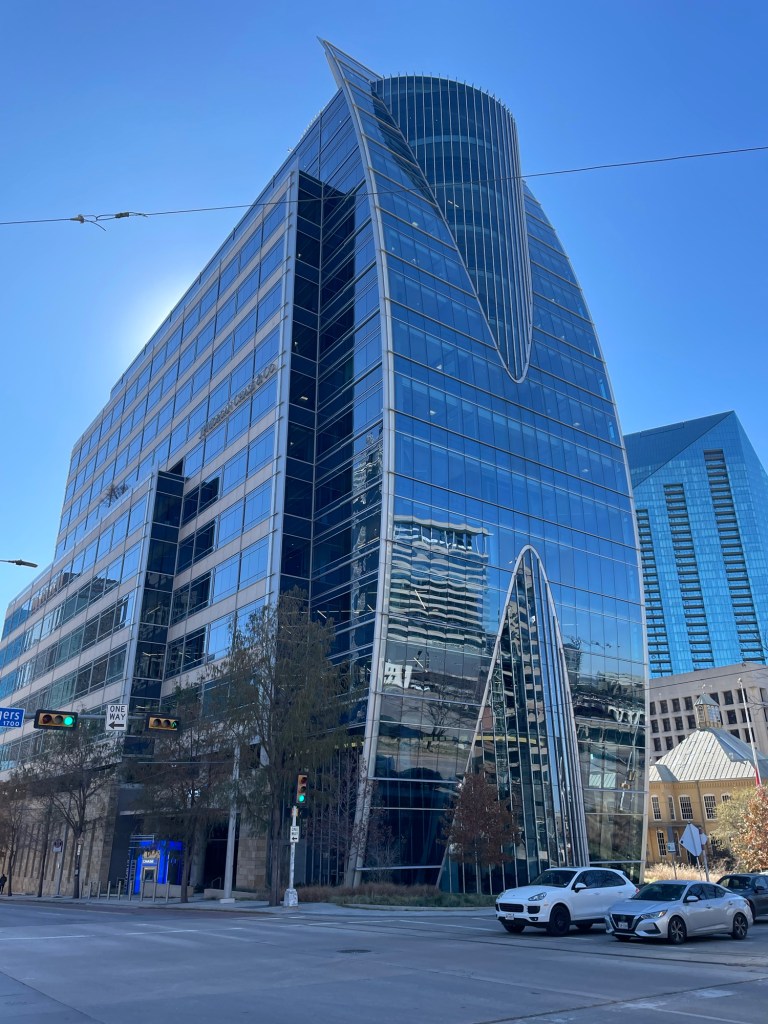
In January 2023, the Dallas Petroleum Club moved to the Hunt building, taking the top 13-14 floors. The top floor became the club’s main dining area, with private dining rooms will be available on the floor below. It is located there today.
This move definitely underscores a strong presence of the Hunt family in the Dallas Petroleum Club that exists in modern times.
Connections analysis
[to be expanded]
Conclusion
Notes
- *) September 19, 2014, Glenda Vosburgh for D Magazine, ‘Inside the Dallas Petroleum Club’; *) January 5, 2017, Nancy Nichols for D Magazine, ‘History of Dallas Food: Lucas Farms in Mesquite’; 1996, Dallas Petroleum Club document, found at the J. Erik Jonsson Central Library
- *) September 19, 2014, Glenda Vosburgh for D Magazine, ‘Inside the Dallas Petroleum Club’; *) https://www.api.org/ *) API Wikipedia page *) 2024, ISGP Studies, ‘Supranational Society’, Liberal: US-centered; *) ISGP, ICC 1921 memberships list, Thomas A. O’Donnell, API President; *) ISGP, ICC Historic members, A.C. Bedford, b. 1863 d. 1925, API co-founder in 1919
- *) September 19, 2014, Glenda Vosburgh for D Magazine, ‘Inside the Dallas Petroleum Club’; *) 1969, AAPG Bulletin;
- *) September 19, 2014, Glenda Vosburgh for D Magazine, ‘Inside the Dallas Petroleum Club’; *) https://www.findagrave.com/memorial/126536284/harry-stuart-moss
- *) September 19, 2014, Glenda Vosburgh for D Magazine, ‘Inside the Dallas Petroleum Club’; 1996, Dallas Petroleum Club document, found at the J. Erik Jonsson Central Library
- *) ibid. *) Wikipedia, Baker Hotel (Dallas)
- *) September 19, 2014, Glenda Vosburgh for D Magazine, ‘Inside the Dallas Petroleum Club’; *) Wikipedia, Atlantic Petroleum
- *) September 19, 2014, Glenda Vosburgh for D Magazine, ‘Inside the Dallas Petroleum Club’; *) August 3, 1982, UPI, ‘Obituaries’
- *) 1973, Jules Archer, ‘The Plot to Seize the White House’; *) Wikipedia, Sunoco
- Wikipedia, Sunoco
- *) 1973, Jules Archer, ‘The Plot to Seize the White House’; *) Wikipedia, J. Howard Pew
- 1973, Jules Archer, ‘The Plot to Seize the White House’
- Wikipedia, J. Howard Pew
- September 19, 2014, Glenda Vosburgh for D Magazine, ‘Inside the Dallas Petroleum Club’
- Wikipedia, Adolphus Hotel
- September 19, 2014, Glenda Vosburgh for D Magazine, ‘Inside the Dallas Petroleum Club’
- 2009, Bryan Burroughs, ‘The Big Rich’
- *) 1964, Warren Commission, Volume 9, George de Mohrenschildt testimony, page 217; *) 1964, Warren Commission, Volume 9, Paul M. Raigorodsky testimony, pages 15-16; *) Wikipedia, cites: 1993, Anthony Summers, ‘Official and Confidential: The Secret Life of J. Edgar Hoover’
- July 21, 1947, TIME, ‘The 60-Day Man’
- Texas State Historical Association, Murchison, Clinton Williams, Sr.
- 2009, Bryan Burroughs, ‘The Big Rich’
- *) Texas State Historical Association, Murchison, Clinton Williams, Sr.; *) 2009, Bryan Burroughs, ‘The Big Rich’
- ibid.
- Texas State Historical Association, Murchison, Clinton Williams, Sr.
- 1993, Anthony Summers, ‘Official and Confidential: The Secret Life of J. Edgar Hoover’
- FindAGrave.com, Burk Yarbrough Murchison
- Wikipedia, Clint Murchison, Sr.
- Texas State Historical Association, Murchison, Clinton Williams, Sr.
- Wikipedia, Clint Murchison, Sr.
- Wikipedia, Clint Murchison, Jr.
- *) 2007, Edward Haslam, ‘Dr. Mary’s Monkey’; *) OschnerHealth, Founding Fathers of Ochsner; *) 2024, ISGP Studies, ‘Supranational Society’
- *) December 11, 2014, The Dallas Morning News, ‘A fortress of power built to last’ *) Source for Hoover needs to be relocated
- January 29, 1950, St. Petersburg Times, ‘Windsor and Wife Leave For Visit to Tallahassee’
- 2009, Bryan Burroughs, ‘The Big Rich’
- *) 2009, Bryan Burroughs, ‘The Big Rich’ *) 1973, Jules Archer, ‘The Plot to Seize the White House’
- 2009, Bryan Burroughs, ‘The Big Rich’
- *) 2009, Bryan Burroughs, ‘The Big Rich’ *) FindAGrave, Joseph McCarthy
- Wikipedia, Clint Murchison, Sr.
- *) Wikipedia, Clint Murchison, Jr.; *) Wikipedia, Sid W. Richardson
- 1964, Warren Commission, Volume 9, Paul M. Raigorodsky testimony
- ibid.
- ibid.
- ibid.
- *) 1964, Warren Commission, Volume 9, George de Mohrenschildt testimony; *) 2009, Bryan Burroughs, ‘The Big Rich’
- 1964, Warren Commission, Volume 9, Paul M. Raigorodsky testimony
- *) July 7, 1982, Deposition of Bernard Fensterwald, Jr., ‘A possible French connection’; *) 1967, New Orleans States-Item, ‘Novel Says Munitions Theft Set up by Agency’
- *) 1964, Warren Commission, Volume 9, George de Mohrenschildt testimony; *) Wikipedia, George de Mohrenschildt
- *) 1964, Warren Commission, Volume 9, George de Mohrenschildt testimony; *) Wikipedia, George de Mohrenschildt
- ibid.
- *) ibid. *) 1964, Warren Commission, Volume 9, Paul M. Raigorodsky testimony
- *) 1964, Warren Commission, Volume 9, George de Mohrenschildt testimony; *) Wikipedia, George de Mohrenschildt
- *) 1964, Warren Commission, Volume 9, George de Mohrenschildt testimony; *) 1964, Warren Commission, Volume 9, Paul M. Raigorodsky testimony; *) Wikipedia, George de Mohrenschildt
- *) 1964, Warren Commission, Volume 9, George de Mohrenschildt testimony; *) Wikipedia, George de Mohrenschildt
- *) 1964, Warren Commission, Volume 9, George de Mohrenschildt testimony; *) Warren Report
- *) 1964, Warren Commission, Volume 9, George de Mohrenschildt testimony; *) 1964, Warren Commission, Volume 9, Jeanne de Mohrenschildt testimony; *) Warren Report
- 1997, Noel Twyman, ‘Bloody Treason’, pages 698-699
- 2000, Donald Gibson, ‘The Kennedy assassination cover-up’,
- *) Wikipedia, Madeleine Duncan Brown; *) Spartacus Education, Madeleine Brown
- *) 1964, Warren Commission, Volume 9, George de Mohrenschildt testimony; *) 1964, Warren Commission, Volume 9, Paul M. Raigorodsky testimony
- *) March 20, 2009, The Dallas Morning News, ‘Downtown Dallas’ Elm Place tower scheduled for foreclosure’; *) October 15, 1961, The Dallas Morning News, ‘First National Plans 50-Story Building’; *) 1997, Metz, Leon, Claire, ‘Robert E. McKee Master Builder’; *) Emporis Buildings, ‘Elm Place‘; *) Wikipedia, ‘First National Bank Tower, Dallas‘
- September 19, 2014, Glenda Vosburgh for D Magazine, ‘Inside the Dallas Petroleum Club’
- 2009, Bryan Burroughs, ‘The Big Rich’
References
- 1936-1940, 1944-1949, 1951-1956, Dallas Petroleum Club By Laws & Members, photocopied at SMU DeGolyer Library
- 1979, Dallas Petroleum Club By Laws & Members, photocopied at the J. Erik Jonsson Central Library
- 1981, Dallas Petroleum Club By Laws & Members, photocopied at the J. Erik Jonsson Central Library
- 1991, Dallas Petroleum Club By Laws & Members, photocopied at the J. Erik Jonsson Central Library
- 1995, Dallas Petroleum Club By Laws & Members, photocopied at the J. Erik Jonsson Central Library
- 2004-2023, Dallas Petroleum Club’s IRS 990 forms, available at ProPublica, containing list of Officers
 Conspiracy Dossiers
Pingback: World Affairs Council of Dallas/Fort Worth: The international hub of Dallas | Conspiracy Dossiers
Pingback: Texas Crusade for Freedom: Domestic intelligence activity in Dallas | Conspiracy Dossiers
Pingback: JM/WAVE: The History of CIA’s Miami Station, 1961-1968 | Conspiracy Dossiers
Pingback: Permindex | Conspiracy Dossiers
Pingback: George Piazza II: Ferrie-Shaw linked lawyer dies in plane crash | Conspiracy Dossiers
Pingback: World Affairs Council of Dallas/Fort Worth: The international hub of Dallas | Conspiracy Dossiers