Author: Carter McLellan – Date: August 4, 2025

Contents
- Who was Nicholas Chetta
- The Case of the Delaunes
- Notes
Who was Nicholas Chetta
Our story begins on June 8, 1916, when Nicholas John Chetta was born in New Orleans, Orleans Parish, Louisiana, USA. His parents were John A. and Concertina Chetta. At this moment, little is known about his family or his upbringing, but his father was a contractor/builder. In any case, he became interested in the medical field and attended LSU Medical School before being drafted into WWII, obtaining a medical degree in 1941. (1)
Since May 1950, Chetta became the coroner for Orleans Parish as part of the Mayorship of Chep Morrison. At some point, Chetta got married to Josae “Dee” Delaune, together they had a son named Nicholas John “Nick” Chetta, Jr., in 1952. (2) At the moment, clear information about Chetta’s career as coroner since 1950 is quite lacking. However, he was a member of various institutions and had taught on various occasions, including at Tulane University. (3)
The JFK assassination connection
We pickup Dr. Chetta’s connection to the Kennedy case on February 22, 1967, during which time he handled the case of David Ferrie‘s controversial death. “Coroner Nicholas Chetta knelt down and sniffed the corpse. “Poison! Poison! he said,”” author Joan Mellen describes. “But Chetta finally ruled that Ferrie had died of natural causes, a ruptured blood vessel at the base of the brain, a “beury aneurysm.”” (4)
Ferrie had been a key suspect in New Orleans District Attorney Jim Garrison‘s investigation into the JFK assassination. All the way back in 1955, Ferrie had apparently met a young Oswald in a New Orleans Civil Air Patrol chapter. Ferrie’s numerous intriguing connections to the case have been described in his respective article, as well as multiple individuals who also ended up dead surrounding the case.
Naturally, Chetta’s conclusion was immediately controversial. Ferrie’s doctor Martin Palmer described the autopsy as “slipshod.” There were two notes found in Ferrie’s apartment Garrison thought were suicide notes, but Chetta concluded they were not suicide notes. There were inconsistencies around the time of death. Initially, Chetta ruled the time to have been before midnight, but a reported claimed he had been with Ferrie until 4am. Jack Martin, notorious for spreading sensational allegations, casted doubt on Chetta’s credibility by claiming Chetta was notorious for selling “natural causes” verdicts, “just like a prostitute.” Apparently examples of this included the deaths of Sheriff Johnny Grosch’s wife, as well as the death of Corinne Morrison, the wife of Mayor Chep Morrison. Chetta also was apparently the coroner of JFK assassination-linked deaths as Robert Perrin (suicide in 1962), Mary Sherman (murder in 1964), and others. (5)
Others who were suspicious of Ferrie’s death included John Wilson, Wendall Roache, and Benton Wilson. Even RFK had apparently been highly interested in following the Garrison investigation and even reportedly contacted Chetta to inquire about the death of Ferrie. RFK himself would end up gunned down the following year. (6)
But things get even more strange by the following month. On February 27, Chetta first met Perry Russo, the key witness for Garrison’s trial, on February 27 at his private office at 3524 Bienville Street. Present were persons from the DA office, then they went to Mercy Hospital where initial vitals were taken an an agreement was made. (7) On February 27, March 9, and March 12, Chetta had overseen three sessions of sodium pentathol and hypnosis on Garrison’s key witness Perry Russo. These sessions were conducted by Dr. Edmond A. Fatter under Chetta’s supervision. The first one took place at Mercy Hospital, then the office of Assistant District Attorney Charles Ward, then lastly in the coroner’s office. This was within days of Russo and Chetta’s testimony for Garrison’s trial against Clay Shaw. Russo was so nervous before testifying that Chetta had to administer a tranquilizer for him. Chetta had maintained that based on these sessions, Russo was credible. (8)
Chetta gave testimony on March 16, 1967, in which he primarily was used to establish that Russo would have currently had better recollection of what had taken place at the time he was questioned about. While he was unable to be asked about his assessment as to the credibility of Russo’s testimony, he apparently believed that there’s “not a chance at all that what this kid said is not true. It had to have happened.” (9)
The death of Chetta
While being a controversial figure in quelling suspicion over Ferrie’s death, then seemingly aiding in Jim Garrison’s manipulation of the JFK case, which heavily discredited the investigation, Dr. Chetta would end up dead himself during the Garrison case.
During the afternoon of May 25, 1968, Chetta suffered an ultimately fatal heart attack, age 51, dying at Mercy Hospital in New Orleans. Where exactly he initially suffered the heart attack has apparently not been reported. His death was quickly added to a growing list of “suspicious deaths” by Penn Jones, Jr. (10)
There doesn’t appear to be any evidence indicating foul play, other than the fact that Chetta had been linked to various “strange deaths” in New Orleans connected to the JFK assassination, as well as playing a questionable role in the Garrison trial. There are other “questionable” heart attack cases including Guy Banister, Tom Howard, Maurice Brooks Gatlin, Earlene Roberts, David Morales, and possibly Lee Bowers. (11)
On May 27, 1968, services were held for Chetta, which included pallbearers Jules E. Delaune and Henry M. Delaune, and honorary pallbearer Dr. Lloyd F. LoCascio, who will all be of particular note soon. (12)
The Case of the Delaunes
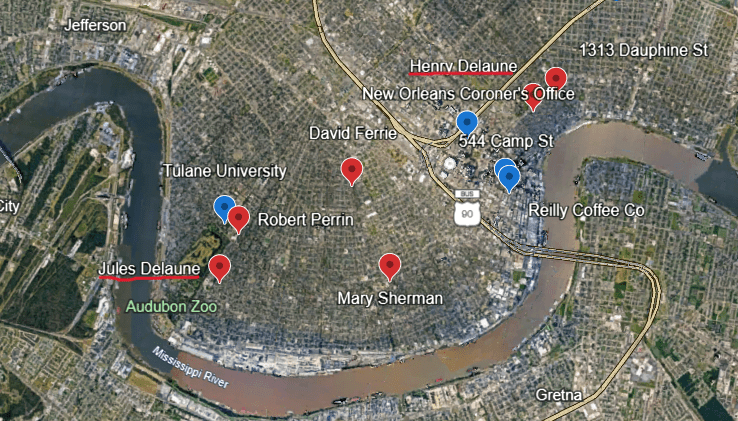
Besides the fact that Dr. Nicholas Chetta died in the middle of the Garrison trial, his death might not seem particularly suspicious except for the fact that two relatives on his wife’s side ended up dead within less than three years after Chetta, and both having worked for the same coroner’s office. (13)
Chetta was married to Josae “Dee” Delaune (1919-2004) by the early 1950’s, having joined the Orleans Parish coroner’s office in 1950. The Delaune family was quite large, but Dee had two siblings of particular interest. Both born in Lockport, Louisiana, one was Jules E. Delaune (1922-1971), the other was Henry M. Delaune (1927-1969). (14)
Jules had moved to New Orleans in 1939, later joining Orleans Parish Coroner’s Office by around 1954, where he worked alongside his brother-in-law Coroner Dr. Nicholas Chetta. Jules worked there for the next 18 years, becoming Chief Clerk Administrator. Meanwhile, his brother Henry M. Delaune, who moved to New Orleans in 1946, from 1956 to 1966, worked at the English Department of Xavier University, where he became a professor and head of that department. During that time period, he was said to have worked at the Orleans Parish Coroner’s Office also as clerk, alongside his brother and brother-in-law. (15)
Henry served in the Navy and attended med-school at LSU. He then went to the University of Missouri where he obtained a BA in Journalism. He also obtained an MA from the Rice Institute in English. He taught at Texas Southern in Houston, the Citadel in Charleston, South Carolina, and at Dillard, before Xavier University. While at Xavier, he was given a grant from the United Negro College Fund‘s faculty fellowship fund to obtain a doctorate degree in 18th Century English at Tulane University. In 1963, he was awarded as an outstanding teacher at Xavier. He later taught English at Nicholls State College in Thibodaux. (16)
In 1962, Chetta’s Coroner’s office reportedly handled the suicide of Robert Perrin. In July 1964, Chetta’s office handled the strange death of Dr. Mary Sherman, whose autopsy was signed off by Assistant Coroner Lloyd F. LoCascio. Then in February 1967, Chetta’s office handled the death of David Ferrie. In February through May 1967, Chetta had been involved in the apparent manipulation of Garrison’s key witness. (17)
A year later, the Garrison trial still ongoing, Dr. Chetta died from a heart attack on May 25, 1968, at the age of 51. On May 27, 1968, the funeral services for Chetta were held bringing together his family, friends and associates. Among the pallbearers were his brothers-in-law, Jules E. and Henry M. Delaune. One honorary pallbearer was Dr. LoCascio. (18) It’s important to underline that it was common for people in Chetta’s age range to suffer from a heart attack, however the life expectancy in the US in 1968 was 70 years old, which could suggest Chetta’s death at 51 was premature. Chetta’s death was examined during the HSCA, but nothing noteworthy was found. (19) With these facts in mind, the suspicion level rises from Chetta’s connection to multiple “strange deaths” related to the JFK assassination, as well as Chetta’s own death in the middle of Jim Garrison’s trial. While officially Chetta’s death was a simple case of heart attack, these facts make it unusual, or convenient in the face of a possible coverup of a conspiracy. This becomes even more remarkable, because two of Chetta’s brothers-in-law who worked in his coroner’s office also died in the following two years. It might also be noteworthy to mention that RFK, who had contacted Chetta to inquire about the death of Ferrie in February 1967, was himself assassinated by Sirhan Sirhan less than a month after the death of Chetta, on June 6, 1968.
The unsolved murder of Henry M. Delaune

Picture of 828 Burgundy Street, pulled from here.
Sometime in late 1968 or early 1969, Henry Delaune had bought a property of apartments at 828 Burgundy Street, in the French Quarter. He rented three apartments there and lived alone in a ground-floor apartment. On the night of January 25, 1969, New Orleans police were summoned to the apartments at 828 Burgundy. They had received a call about a disturbance in the vicinity, gunshots were heard. Unable to enter the apartment, nothing was found, and they left. However, shortly before 12:50 am on January 26, 1969, police were summoned to the apartment again after a resident returning from a trip discovered a body. (20)
Once arrived, police were met by Miss Joan Babbitt, 23, of 826 Burgundy, and Case Casso, 23. The body was that of Henry M. Delaune, 41, who was found naked in the doorway of his apartment with two gunshot wounds to the chest. No gun was found and Commander of the New Orleans Police Homicide Division Captain Anthony Polito stated “We know practically no more than that the man was shot by a person unknown to us. We are convinced that it is a homicide, principally because no weapon was found.” Furthermore, police said it appeared robbery was not the motive for the murder, but a check was being made to determine if anything valuable was missing. (21)
Henry Delaune’s funeral was held on January 27, 1969 at Leitz-Eagan Funeral Home. Meanwhile investigators brought in suspect into the Central Lockup. The man, a tall young blond, was booked as a deserter of the Marines, but police were satisfied by January 28 that the man had no connection to the murder of Henry Delaune. (22)
The death of Jules E. Delaune
Nearly two years after the death of his brother, Henry M. Delaune, and almost three years after the death of his brother-in-law Nicholas Chetta, Jules E. Delaune died on January 10, 1971, at the age of 48. Funeral services were held on January 11, 1971, taking place at Leitz-Eagan Funeral Home, with interment at Hope Mausoleum. (23)
There currently is no easily available information about the exact cause of Jules Delaune’s death. Again, we know he worked at Chetta’s coroner’s office during the period that they handled multiple “strange death” cases. He was the brother of Henry Delaune, who was murdered by an unknown gunman. Presumably Jules Delaune had died from natural causes, perhaps a heart attack like Chetta. However, Jules was still quite young, just 48 years old. Jules was living at 5151 Webster Street at the time of his death, which was likely where he would have suffered from a heart attack on that Sunday. (24) It appears ISGP is the only researcher who caught the death of Jules E. Delaune and marked it down as possibly suspicious.
Notes
- *) https://www.findagrave.com/memorial/240563501/nicholas_john-chetta; *) March 16, 1967, Nicholas J. Chetta testimony
- *) https://www.findagrave.com/memorial/240563501/nicholas_john-chetta; *) January 19, 1950, West Bank Herald, page 8; *) March 16, 1967, Nicholas J. Chetta testimony
- March 16, 1967, Nicholas J. Chetta testimony, “I belong to the American Medical Association; belong to the Orleans Parish Medical Association, of which I am an officer; I belong to the Louisiana State Medical Society, which I am first vice president. I belong to the International College of Surgeons; I belong to the Graduate Medical Assembly. I belong to the American Academy of Forensic Science. I belong to the National Coroner’s Association, of which I am a past president. Also had teaching assignments at LSU Medical School, Tulane Medical School, and have been, on occasion, guest lecturer at Tulane Law School; I have taught in the School of Nursing at Mercy Hospital, and there are some others, but I think that should cover the field.”
- 2005, Joan Mellen, ‘A Farewell to Justice’
- *) ibid.; *) Penn Jones, Jr., ‘Forgive My Grief’, Volume III
- 2005, Joan Mellen, ‘A Farewell to Justice’
- March 16, 1967, Nicholas J. Chetta testimony
- *) 2005, Joan Mellen, ‘A Farewell to Justice’; *) March 16, 1967, Daily Word, ‘DA Thrice Directed Hypnosis, Says Russo’; *) March 17, 1967, Lake Charles American-Press, ‘Coroner tells of Russo’s hypnosis’; *) March 16, 1967, Nicholas J. Chetta testimony
- *) March 16, 1967, Nicholas J. Chetta testimony; *) 2005, Joan Mellen, ‘A Farewell to Justice’
- *) https://www.findagrave.com/memorial/240563501/nicholas_john-chetta; *) Penn Jones, Jr., ‘Forgive My Grief’, Volume III
- https://isgp-studies.com/death-list-potential-government-assassinations#jfk
- May 27, 1968, New Orleans States-Item, ‘Services Held for Coroner Nicholas Chetta’
- https://isgp-studies.com/death-list-potential-government-assassinations#jfk
- *) https://www.findagrave.com/memorial/8807093/josae_%22dee%22-nunez; *) https://www.findagrave.com/memorial/164606833/jules-e-delaune; *) January 27, 1969, New Orleans States-Item, ‘Police Baffled By Prof’s Slaying’, available on ISGP, “Police baffled today by the slaying of Henry M. Delaune, 41-years-old …”
- *) January 11, 1971, New Orleans States-Item, ‘J.E. Delaune Funeral Rites Conducted’, available on ISGP; *) January 27, 1969, New Orleans States-Item, ‘Police Baffled By Prof’s Slaying’, available on ISGP; *) May 1963, The Xavier Herald, ‘Henry M. Delaune Receives Herald’s Outstanding Teacher Reward’, (page available here)
- *) May 1963, The Xavier Herald, ‘Henry M. Delaune Receives Herald’s Outstanding Teacher Reward’, (page available here); *) January 27, 1969, New Orleans States-Item, ‘Police Baffled By Prof’s Slaying’, available on ISGP; *) January 27, 1969, New Orleans Times-Picayune, ‘Body is Found-Killer Sought’, (available here); January 28, 1969, Times-Picayune, ‘Slain Teacher is Remembered’, (available here)
- *) Penn Jones, Jr., ‘Forgive My Grief’, Volume III; *) 2005, Joan Mellen, ‘A Farewell to Justice’; *) March 17, 1967, Daily News, ‘USed Truth Serum on Russo’, (available on ISGP);
- *) May 27, 1968, New Orleans States-Item, ‘Services Held for Coroner Nicholas Chetta’, (available on ISGP)
- *) https://www.ssa.gov/OACT/TR/TR02/lr5A3-h.html; *) June 5, 1978, Thomas H. Neale of Congressional Research Service, ‘Analysis of Reports and Data Bearing on Circumstances of Death of Twenty-One Individuals Connected with the Assassination of President Kennedy’ (Link: https://www.jfk-assassination.net/crs.htm#death6)
- *) January 27, 1969, New Orleans States-Item, ‘Police Baffled By Prof’s Slaying’; *) January 27, 1969, New Orleans Times-Picayune, ‘Body is Found-Killer Sought’; *) January 28, 1969, Times-Picayune, ‘Slain Teacher Is Remembered’; (articles available here)
- ibid.
- ibid.
- *) January 11, 1971, New Orleans States-Item, ‘J.E. Delaune Funeral Rites Conducted’ (available on ISGP); https://www.findagrave.com/memorial/164606833/jules-e-delaune
- ibid.
 Conspiracy Dossiers
Pingback: Guy Banister: The Heart of Oswald-linked Anti-Castro Activity in New Orleans | Conspiracy Dossiers