Author: Carter L. McLellan – Date: September 10, 2025
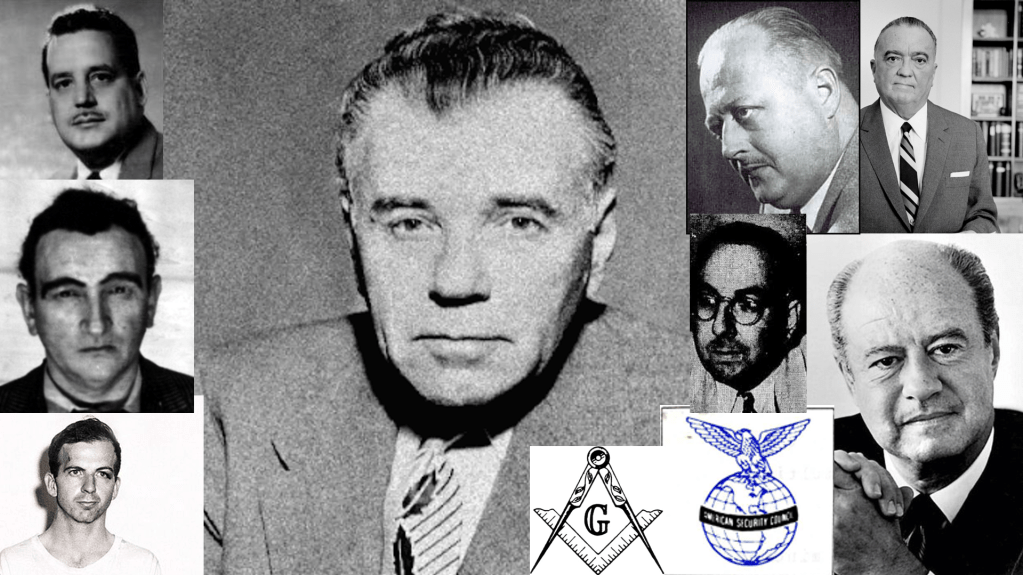
Content
- Timeline of Guy Banister’s Life
- Connections
- Notes
Timeline of Guy Banister’s Life
Early Years (1901-1934)
The person of interest in this article, William Guy Banister, apparently in a log cabin, was born on March 7, 1901, in Monroe, Ouachita Parish, Louisiana, USA. He was the first child of William Henry Banister (1876-1940) and Margaret Aline Gregory (1884-1982).1 His siblings were Max (1903-1903), Ellie May (1904-1952), Ray Gregory (1905-1946), Roy Henry (1908-1950), Troy E. (1912-1925), and Donald Ross (1914-1996). In 1903, when Banister was just two years old, his first sibling, Max, apparently died the same day he was born, and was buried at Mount Olive Baptist Church Cemetery, in West Monroe.2 Not much is currently known about Guy’s youth, but he and his siblings joined the Boy Scouts and their father was a city jailer from 1923 to 1929, Deputy Sheriff from 1929 to 1940, and Freemason.3
Not much information seems to be available about Banister’s education, but he reportedly attended Louisiana State University (LSU), and Soule Business College, where he met George Soule.4 In 1925, Banister was working for the Missouri Pacific Railroad as a ticket taker. 5 It was also in 1925 that one of Banister’s brothers, Troy, was fatally electrocuted by chain supporting electric light wires running above a street. The Banister family sued the City of Monroe for wrongful death and their lawyer became the notorious Huey P. Long (1893-1935).6
In 1931, a brother-in-law was accidentally shot while looking for a Christmas tree. Banister managed to treat his wounds saving his life. He credited his time in the Boy Scouts with giving him the knowledge to handle the injury. Additionally, Banister must’ve been married at this point to Mary Roberta Wortham (1904-2001). 7
Law Enforcement Career (1934-1957)
At some point, Guy Banister had joined the Monroe Police Department.8 In 1934, Banister joined the Division of Investigation (DOI), where he would serve for the next 20 years. The DOI was renamed to the Federal Bureau of Investigation (FBI) in 1935. Originally, Banister was based out of Indianapolis, and apparently had some proximity to the killing of John Dillinger, in 1934. Later, Banister moved to New York City where he helped investigate the American Communist Party.9
In 1938, FBI Director Edgar J. Hoover apparently impressed by Banister’s work, promoted him to Special Agent in Charge for the unit in Butte, Montana. He would also serve in Oklahoma City, Minneapolis and Chicago.10 In December 1944, Banister was in charge of the investigation into the fatal Fu-Go balloon bomb near Kalispell, Montana.11 During the 1947 flying disc craze, Banister investigated a saucer hoax in Twin Falls, Idaho.12
In the latter part of Banister’s career at the FBI, while SAC of the Chicago field office, he was apparently the superior of Robert Maheu, who worked for the FBI between 1941 and 1947. After twenty years of service in the FBI, Banister retired in 1954 and moved back to Louisiana.13 In January 1955, Banister moved to New Orleans, where he became the Assistant Superintendent of the New Orleans Police Department. He was tasked with investigating organized crime and corruption within the police department. Furthermore, he was also involved in looking at the role of left-wing political activists in the struggle for black civil rights in New Orleans.14
In December 1955, publicly revealed 91 policemen involved in “graft”, which caused some controversy in New Orleans and Banister was reprimanded.15 Banister remained with the NOPD until an incident around March 1957, when witnesses reported that he had drawn his revolver while threatening a bartender at the Old Absinthe House on Bourbon Street in the French Quarter. NOPD Superintendent Provosty Dayries then suspended Banister, despite him denying the allegations.16
Later in March 1957, Banister appeared before the Joint Legislative Segregation Committee where he claimed to have proof of a communist plot to promote friction between races in the USA.17 When Banister’s suspension was over in June, he was asked to reassign to the department’s chief of planning, however, he refused and was dismissed by Dayries for “open defiance.”18
Private Investigator Career (1957-1964)
Following Banister’s dismissal from the NOPD, he swiftly went into the private investigator business, launching Guy Banister Associates, Inc., after which things seem to get increasingly parapolitical around him. He had an office on Robert E. Lee Boulevard, but later moved to 434 Balter Building at 4532 Magnolia. A 1959 yellow page ad shows the services he provided included consultation, analysis, confidential civil and criminal investigations, industrial protection and surveys, as well as personality analysis.19
One of his early employees was Joseph Oster, who became dissatisfied the Banister did not take an interest in cases that would have made the firm more money. He recalled that Banister used two important sources for information, Fidelafax and the American Security Council, which was often used for security checks about political backgrounds with special interest in any community type activates. Both organizations were headed mostly by retired FBI agents. Furthermore, employees of Banister included Carmen Bollino and John Sullivan, both former FBI agents. Oster recalled that Banister, known as “The Chief”, maintained direct contact with FBI Chief J. Edgar Hoover, and was also in contact with someone from the CIA. Others who reportedly worked for Banister were Hugh F. Ward and David Ferrie.20
In June 1960, Banister moved his business to the Newman Building at 531 Lafayette Street. From October 1961 to February 1962, the building was also used by the Cuban Revolutionary Council and Sergio Arcacha Smith‘s Crusade to Free Cuba Committee.21
In 1961, Banister helped organize the Friends of Democratic Cuba, which raised funds for the CRC, in-turn backed by the CIA in opposition to Castro. Furthermore, Banister was reportedly the head of the Anti-Communism League of the Caribbean, which was founded in the early 1950’s. In a letter to Guy Johnson dated August 1960, Banister discusses the legal counsel of this organization, Maurice Brooks Gatlin, who reportedly had at some point been seen at Banister’s office. In 1958, the league was joined by Felix Rodriguez, a top CIA assassin.22 In April 1961, Banister was reportedly working with Sergio Arcacha Smith of the CRC. whose office was located across the hall from Banister’s office. 23
A highly intriguing event took place in 1961. Various sources have implicated Banister alongside David Ferrie, Sergio Arcacha Smith, and Gordon Novel, in a “raid” on a Schlumberger arms depot in Houma. Some of the weapons were allegedly stored in Banister’s “back room.” He allegedly supplied munitions for the 1961 Bay of Pigs Invasion and continued to deal weapons from his office.24 These arms were allegedly originally intended for the OAS, which was attempted to destabilize Algeria and assassinate Charles de Gaulle of France. Very interesting is the fact the the earlier mentioned Maurice Brooks Gatlin, in 1962, had allegedly been a conduit for CIA funds to the OAS. He was allegedly dispatched by Banister to deliver a briefcase of $200,000 to the paramilitary group.25
In 1963, Banister and Ferrie began working for G. Wray Gill, lawyer of Carlos Marcello in an effort to prevent his deportation to Guatemala.26 During the summer of 1963, Banister was involved in helping Ferrie’s grievance case against Eastern Airlines.27
In August 1963, Lee Harvey Oswald was in New Orleans distributing Fair Play for Cuba Committee (FPCC) pamphlets, some of which had the address of 544 Camp Street, which was an address to the Newman Building where Banister had his office. Reportedly, Oswald had attempted to infiltrate the DRE office at that address, meeting Carlos Bringiuer. DRE was connected to Georges Joannides of the CIA’s JM/WAVE station. Various claims around Oswald’s connection to Banister originate from this episode.28
In September 1963, Banister allegedly met Kerry Thornley, a strange character in the JFK saga who had met Oswald in the 1950’s.29
Probably the most notorious aspect of Banister occurred in the afternoon of November 22, 1963. Banister and Jack Martin went drinking together after the assassination. On their return to Banister’s office the two men got involved in a dispute about a missing file. Banister became so angry that he he drew his Magnum revolver and hit Martin with it several times. Martin was so badly injured that he had to be detained in the local Charity Hospital.30
On November 25, 1963, Martin was contacted by the Federal Bureau of Investigation. He told them that he thought Ferrie had hypnotized Oswald into assassinating Kennedy. The FBI considered Martin’s evidence unreliable and decided not to investigate Banister and Ferrie. This information eventually reached Jim Garrison, the district attorney of New Orleans. He interviewed Martin about these accusations. Martin claimed that during the summer of 1963 Banister and David Ferrie were involved in something very sinister with a group of Cuban exiles.31
Meanwhile, Banister continued with his business. Between 1963 to 1964, Banister had reportedly hired Ferrie and Martin to investigate a nickel deal in Cuba involving Clay Shaw and Richard White of Freeport Mineral.32
Death of Guy Banister (1964)
On June 4, 1964, Guy Banister died from coronary thrombosis at his apartment located at 1031 Moss Street, Apartment B, New Orleans, Louisiana. I. E. Nitschke, a former associate of Banister, his wife, and Delphine Roberts, the secretary of Banister Associates, drove to Banister’s house that day thinking something was wrong with him. Once they, they attempted to reach Banister but he was not responding.33
The group decided to force the door open to get inside. They discovered Banister’s body lying in his bed, then called the New Orleans police. Responding officers were Patrolmen F. Wilson, F. Hayward and recruit R. Busby. They interviewed Roberts who stated that Banister had picked her up at their office the previous day and drove her to her house where they ate dinner with her mother. At the time, Banister complained of not feeling too well. He then left for his apartment.34
The next day, Roberts attempted to contact Banister but he did not respond. She went to his apartment and was unable to reach him there, so she contacted Nitschke for assistance. Police Sergeant Polito arrived not long after the responding officers got there. Detectives C. Drumm and D. Kent, Technician George Steib and Sam Moran, a special investigator for the coroner’s office, arrived as well. At 8pm, Dr. Nicholas Chetta, the New Orleans coroner, arrived and pronounced Banister dead at 8:02 pm. Moran removed some weaponry and Banister’s body was taken to the City Morgue. He was later buried at Riverview Cemetery.35
Later, New Orleans Assistant District Attorney Andrew Sciambra interviewed Banister’s widow, Mary Banister. She recalled seeing some Fair Play for Cuba leaflets in Banister’s office when she went there following his death.36
Connections of interest
There are numerous connections to Banister and tons of documents around him. The following section will summarize some of the ties that were of particular interest. Other ties that did not have a clear timeframe will also be noted here.
The Banister Family
Usually we start this section with a recap of the subject’s family. The Banister family was prominent through local public service in Monroe, Louisiana. Guy Banister (1901-1964) was part of a large family and his father was a city jailer from 1923 to 1929, and a Deputy Sheriff from 1929 to 1940.37 Guy and his brothers joined the Boy Scouts,38 one of the largest youth organizations in the US. Founded in 1910, it has included numerous prominent persons throughout the decades.
Another interesting connection of the Banister family was to Huey P. Long (1893-1935)39, who once served as a lawyer for the family. The family had sued the City of Monroe for the wrongful death of one of their children. Long, a controversial native of Louisiana, was assassinated in 1935.
Educational links
Guy Banister’s educational background appears to include attendance at Louisiana State University (LSU), a very prominent university in the state located in Baton Rouge and founded in 1860. Banister also attended Soule Business College, where he made one of his earliest intriguing contacts to George Soule.40 There does not appear to be a great deal of information about this Soule character. It appears he was a different George Soule then the founder of Soule Business College, but did serve as a President.41
There does appear to be some information easily available about the George Soule in question. The Soule family was reportedly involved in Draper’s American Coalition of Patriotic Societies, started by Major John B. Trevor, Sr., and Pioneer Fund.42 These two organizations were heavily linked to the eugenics movement. Soule also reportedly had contact with Dan Smoot and H. L. Hunt, as well as Medford Evans, all linked to the John Birch Society. Furthermore, in 1963, Soule was chairman of the 12th Annual National Congress for Freedom, in which General Edwin Walker gave a speech, and the curious Joseph Milteer was in attendance.43 All of this is consistent with the conservative establishment ties of Guy Banister
Conservative Establishment ties
Following his education, Banister joined the Monroe Police Department.44 In 1934, he then joined the newly established Division of Investigation (DOI), which eventually became the FBI. Seemingly he became a protege of J. Edgar Hoover, who would maintain close contact with Banister after he left the bureau. He then went to serve in the New Orleans Police Department, from 1955 to 1957.45
It was definitely during this period that he developed anti-communist and conservative views. He was said to have published an anti-communist periodical called the Louisiana Intelligence Digest.46 Other reports have identified Banister as a member of the Minutemen and John Birch Society, and have linked him to the World Anti-Communist League (WACL).47
Then there was all the highly intriguing activity around Guy Banister Associates, which Banister founded after he was fired from NOPD. He also founded the Citizens for a Free Cuba which was set up at the notorious 544 Camp Street address. Banister’s anti-Castro activities put him into contact with figures as David Ferrie and Sergio Arcacha Smith.48 In 1955, an organization called the Anti-Communism League of the Caribbean came to New Orleans and was headed by Banister. That organization included his deputy Hugh F. Ward and Maurice Brooks Gatlin. It was also joined by Felix Rodriguez, a CIA assassin from Cuba.
One fascinating link through Guy Banister Associates was its utilization of the American Security Council‘s database49. The ASC has been described as a Cold War joint CIA-FBI-Pentagon front involved in illegal operations. Banister also reportedly used Fidelifax, which performed FBI type background investigations for the corporate sector. Another interesting tie is Banister’s reportedly connection to Ed Butler, the Director of the Information Council of the America’s and member of the ASC.50
Links with Permindex
Banister has been linked to Permindex, which had Clay Shaw on its board, in a few intriguing ways. In 1961, there was a raid on a Schlumberger arms depot in Houma. That raid allegedly involved David Ferrie, Sergio Arcacha Smith and Gordon Novel. Various reports have attempted to link this group to CIA operative David Atlee Phillips. Supposedly the CIA was involved in setting up this raid.51
The stolen arms were allegedly intended for the OAS, which was attempted to assassinate Charles de Gaulle of France over the Algeria situation. The earlier mentioned Maurice Brooks Gatlin had also been linked to funneling CIA funds to the OAS. Furthermore, a secretary at Banister’s office, Delphine Roberts, claimed that she saw Ferenc Nagy, a key figure in Permindex.52
It might be worth mentioning that Guy Banister, like his father, was a Freemason and a Shriner.53 Permindex was heavily linked to the P2 lodge. While in the FBI during WWII, Banister had reportedly work with William Harvey54, the CIA spook who later was sent to Rome following the Cuba Crisis where he got involved in P2-Gladio operations.
Harvey was involved in the CIA’s anti-Castro efforts which was ran out of the JM/WAVE station. That in turn had ties to Oswald, such as through the New Orleans DRE and Butler.
Links to the Mafia
Banister and Ferrie were closely linked to G. Wray Gill, the lawyer of Carlos Marcello. Delphine Roberts has also claimed that Johnny Roselli visited Banister’s office.55 Harvey had also worked with Roselli in the CIA’s anti-Castro operations.
Another intriguing contact Banister reportedly made in the FBI was to Robert Maheu56, who later for the CIA was tasked with recruiting organized crime figures like Roselli and Giancana, and Trafficante for anti-Castro operations. Maheu would also be linked to the “Octopus” through an organization called FIDCO, but this was much later after Banister had died.
Ties to other “strange deaths”
Guy Banister, like Oswald, Ruby and Ferrie, were linked to a series of “strange deaths.” One of those was Nicholas Chetta, the coroner who handled many of these cases and who died in the middle of the Garrison trial, which he had helped manipulate. Several people who worked for Banister, Hugh F. Ward, John Sullivan, Maurice Brooks Gatlin, David Ferrie, all ended up dead under suspicious circumstances. The intimidation of Jack Martin should also be considered strange.57
Notes
- *) Find a Grave, William Guy Banister, https://www.findagrave.com/memorial/18533329/william_guy-banister;
*) HSCA Final Assassination Report – Appendix to Hearings – Volume X, Part XIII. 544 Camp Street and Related Events, https://www.history-matters.com/archive/jfk/hsca/reportvols/vol10/pdf/HSCA_Vol10_AC_13_544Camp.pdf, “According to one of Banister’s own biographical sketches dated March 1964, he was born in a log cabin in rural Louisiana in 1901, the eldest of 7 children.(56) [cites: Material received from files of New Orleans district attorney’s office pertaining to investigation and trial of Clay Shaw, 1967-69, attachment D, section 5, regarding Guy Banister, “Biographical Sketch” (J. F. K. Document 007271).]”;
*) Find a Grave, William Guy Banister, ↩︎ - *) Find a Grave, William Guy Banister, https://www.findagrave.com/memorial/18533329/william_guy-banister;
*) Find a Grave, Max Banister, https://www.findagrave.com/memorial/90400030/max-banister ↩︎ - *) Find a Grave, William Henry Banister, https://www.findagrave.com/memorial/18265015/william_henry-banister;
*) Janet Banister, Skeletons in the Closet Podcast, Season 1, Episode 1, https://shows.acast.com/skeletons-in-the-closet/episodes/the-many-faces-of-guy-banister-final ↩︎ - ISGP, American Security Council, Historical Membership List, https://isgp-studies.com/american-security-council-membership-list, “Great piece of work, Mark. Just recently I discovered that Guy Banister attended Soule Business College right after Louisiana State and remained a close friend of George Soule …” ↩︎
- Janet Banister, Skeletons in the Closet Podcast, Season 1, Episode 2, https://shows.acast.com/skeletons-in-the-closet/episodes/the-banisters-and-huey-p-long-the-kingfish-of-louisiana ↩︎
- Find a Grave, Troy E. Banister, https://www.findagrave.com/memorial/18264991/troy_e-banister ↩︎
- *) Janet Banister, Skeletons in the Closet Podcast, Season 1, Episode 2, https://shows.acast.com/skeletons-in-the-closet/episodes/the-banisters-and-huey-p-long-the-kingfish-of-louisiana;
*) Find a Grave, William Guy Banister, https://www.findagrave.com/memorial/18533329/william_guy-banister ↩︎ - HSCA Final Assassination Report – Appendix to Hearings – Volume X, Part XIII. 544 Camp Street and Related Events, https://www.history-matters.com/archive/jfk/hsca/reportvols/vol10/pdf/HSCA_Vol10_AC_13_544Camp.pdf, “He started his career in criminal justice with the police department of Monroe, La. (57) [cites: Material received from files of New Orleans district attorney’s office pertaining to investigation and trial of Clay Shaw, 1967-69, attachment D, section 5, regarding Guy Banister, “Biographical Sketch” (J. F. K. Document 007271).]” ↩︎
- *) HSCA Final Assassination Report – Appendix to Hearings – Volume X, Part XIII. 544 Camp Street and Related Events, https://www.history-matters.com/archive/jfk/hsca/reportvols/vol10/pdf/HSCA_Vol10_AC_13_544Camp.pdf, “In 1934, he be came a special agent for the agency of the Department of Justice that was soon to be named the Federal Bureau of Investigation. (58) [cites: Material received from files of New Orleans district attorney’s office pertaining to investigation and trial of Clay Shaw, 1967-69, attachment D, section 5,regarding Guy Banister, “Biographical Sketch” (J. F. K. Document 007271).] Banister served in the FBI for 20 years, …”;
*) Wikipedia, Guy Banister, https://en.wikipedia.org/wiki/Guy_Banister#Early_life_and_law_enforcement_career “In 1934, Banister joined the Federal Bureau of Investigation. He was present at the killing of John Dillinger. Originally based in Indianapolis, he later moved to New York City where he was involved in the investigation of the American Communist Party.”;
*) Wikipedia, FBI, https://en.wikipedia.org/wiki/Federal_Bureau_of_Investigation#History, “The following year, 1933, the BOI was linked to the Bureau of Prohibition and rechristened the Division of Investigation (DOI); it became an independent service within the Department of Justice in 1935.[18] In the same year, its name was officially changed from the Division of Investigation to the Federal Bureau of Investigation (FBI).” ↩︎ - Wikipedia, Guy Banister, https://en.wikipedia.org/wiki/Guy_Banister#Early_life_and_law_enforcement_career, “FBI Director J. Edgar Hoover was impressed by Banister’s work and, in 1938, he was promoted to run the FBI unit in Butte, Montana. … He also served in Oklahoma City, Minneapolis and Chicago. In Chicago, he was the Special Agent in Charge for the FBI.”;
*) HSCA Final Assassination Report – Appendix to Hearings – Volume X, Part XIII. 544 Camp Street and Related Events, https://www.history-matters.com/archive/jfk/hsca/reportvols/vol10/pdf/HSCA_Vol10_AC_13_544Camp.pdf, “Banister served in the FBI for 20 years, 17 of those years as special
agent in charge. (59) [cites: Material received from files of New Orleans district attorney’s office per taining to investigation and trial of Clay Shaw, 1967-69, attachment D, section 5, regarding Guy Banister, “Biographical Sketch” (J. F. K. Document 007271).]” ↩︎ - Wikipedia, Guy Banister, https://en.wikipedia.org/wiki/Guy_Banister#Early_life_and_law_enforcement_career, “In December 1944, Banister was charged with investigating a fatal Fu-Go balloon bomb near Kalispell, Montana. (cites: 2014, Ross Coen, ‘Fu-go: The Curious History of Japan’s Balloon Bomb Attack on America‘)” ↩︎
- Wikipedia, Guy Banister, https://en.wikipedia.org/wiki/Guy_Banister#Early_life_and_law_enforcement_career, “During the 1947 flying disc craze, Banister investigated a hoaxed saucer in Twin Falls. (cites: Fort Collins Coloradoan 11 Jul 1947, page 1)” ↩︎
- *) Wikipedia, Guy Banister, https://en.wikipedia.org/wiki/Guy_Banister#Early_life_and_law_enforcement_career, “In Chicago, he was the Special Agent in Charge for the FBI.” [cites: 1979, HSCA Final Assassination Report – Appendix to Hearings – Volume X, Part XIII. 544 Camp Street and Related Events];
*) ISGP, American Security Council, Historical Membership List, https://isgp-studies.com/american-security-council-membership-list, “He served in the FBI, eventually retiring as the Special Agent in Charge of the Chicago office in 1955 after 20 years of service. (In that capacity, he was [apparently] the superior to Robert Maheu during Maheu’s service in Chicago; see below.) … Robert Maheu once worked under him. Also close to Maheu through his employee Bellino.”;
*) Wikipedia, Robert Maheu, https://en.wikipedia.org/wiki/Robert_Maheu#Early_life, “In 1941, during his law studies at Georgetown, he was hired by the FBI and worked as a counter-intelligence officer in Europe during World War II.” (cites: 2000, Anthony Summers, ‘The Arrogance of Power, page 153);
*) 1979, HSCA Final Assassination Report – Appendix to Hearings – Volume X, Part XIII. 544 Camp Street and Related Events, “He retired in 1954…” ↩︎ - *) Spartacus Educational, Guy Banister, https://spartacus-educational.com/JFKbannister.htm;
*) November 15, 2013, John Pope for The Times-Picayune, ‘JFK assassination conspiracy: Former FBI agent Guy Banister was on the fringes of investigation’, https://web.archive.org/web/20131120173459/http://www.nola.com/politics/index.ssf/2013/11/jfk_assassination_conspiracy_g.html, “He retired from the FBI in 1954. In January 1955, he was named assistant superintendent of the New Orleans Police Department, where he was in charge of investigating organized crime and corruption within the force, as well as the role of left-wing groups in the local civil rights movement.” ↩︎ - December 30, 1955, The Daily Advertiser, ‘Police Officer Reprimanded in Graft Probe’, https://www.newspapers.com/image/536588715 ↩︎
- *) https://archive.org/details/foia_Banister_Guy_HQ-1/page/n103/mode/2up;
*) https://archive.org/details/foia_Banister_Guy_HQ-1/page/n111/mode/2up;
*) https://archive.org/details/foia_Banister_Guy_HQ-1/page/n106/mode/1up ↩︎ - https://www.newspapers.com/image/213743367/ ↩︎
- *) https://archive.org/details/foia_Banister_Guy_HQ-1/page/n167/mode/2up;
*) https://archive.org/details/foia_Banister_Guy_HQ-1/page/n171/mode/2up; ↩︎ - *) January 27, 1978, HSCA, Delsa & Robert Buras report of an interview with Joseph Oster;
*) David Ferrie, House Select Committee on Assassinations – Appendix to Hearings, Volume 10, 12, p. 110.;
*) https://web.archive.org/web/20131120173459/http://www.nola.com/politics/index.ssf/2013/11/jfk_assassination_conspiracy_g.html;
*) https://en.wikipedia.org/wiki/Guy_Banister?wprov=sfti1#Private_investigation,_Cuba,_Oswald,_Marcello ↩︎ - *) January 27, 1978, HSCA, Delsa & Robert Buras report of an interview with Joseph Oster;
*) https://isgp-studies.com/misc/death-list/articles/1965_05_Maurice_Brooks_Gatlin_death ↩︎ - *) David Ferrie, House Select Committee on Assassinations – Appendix to Hearings, Volume 10, 12, p. 110.;
*) Appendix to Hearings before the Select Committee on Assassinations of the U.S. House of Representatives, Volume X 1979, p. 123-124 ↩︎ - *) https://isgp-studies.com/american-security-council-membership-list;
*) https://isgp-studies.com/ngo-list-foundations-and-think-tanks-worldwide;
*) https://isgp-studies.com/misc/death-list/articles/1965_05_Maurice_Brooks_Gatlin_death ↩︎ - https://isgp-studies.com/american-security-council-membership-list; ↩︎
- *) https://isgp-studies.com/1001 ;
*) Appendix to Hearings before the Select Committee on Assassinations of the U.S. House of Representatives, Volume X 1979, p. 127.;
*) New Orleans States-Item, April 25, 1967 ↩︎ - *) https://isgp-studies.com/misc/death-list/articles/1965_05_Maurice_Brooks_Gatlin_death;
*) https://en.wikipedia.org/wiki/Guy_Banister?wprov=sfti1#Private_investigation,_Cuba,_Oswald,_Marcello ↩︎ - *) ppendix to Hearings before the Select Committee on Assassinations of the U.S. House of Representatives, Volume X 1979, p. 127.;
*) Summers, Anthony. Not in Your Lifetime, (New York: Marlowe & Company, 1998), p. 240. ↩︎ - *) David Ferrie, House Select Committee on Assassinations – Appendix to Hearings, Volume 10, 12, p. 111.;
*) Appendix to Hearings before the Select Committee on Assassinations of the U.S. House of Representatives, Volume X 1979, p. 127. ↩︎ - *) https://spartacus-educational.com/JFKbannister.htm ;
*) 1980, Anthony Summers, ‘The Kennedy Conspiracy’, “According to Delphine Roberts, Lee Oswald walked into her office sometime in 1963 and asked to fill in the forms for accreditation as one of Banister’s “agents.” Mrs. Roberts told me, “Oswald introduced himself by name and said he was seeking an application form. I did not think that was really why he was there. During the course of the conversation I gained the impression that he and Guy Banister already knew each other. After Oswald filled out the application form Guy Banister called him into the office. The door was closed, and a lengthy conversation took place. Then the young man left. I presumed then, and now am certain, that the reason for Oswald being there was that he was required to act undercover.”;
*) Summers, Anthony. Not in Your Lifetime, (New York: Marlowe & Company, 1998), p. 229, “Mrs. Roberts said she was sure that whatever the nature of Banister’s “interest” in Oswald, it concerned anti-Castro schemes, plans which she feels certain had the support and encouragement of government intelligence agencies. As she put it, “Mr. Banister had been a special agent for the FBI and was still working for them. There were quite a number of connections which he kept with the FBI and the CIA, too. I know he and the FBI traded information due to his former association….”
Banister’s secretary, Delphine Roberts, told author Anthony Summers that Oswald “seemed to be on familiar terms with Banister and with [Banister’s] office.” Roberts said, “As I understood it, he had the use of an office on the second floor, above the main office where we worked. Then, several times, Mr. Banister brought me upstairs, and in the office above I saw various writings stuck up on the wall pertaining to Cuba. There were various leaflets up there pertaining to Fair Play for Cuba.'”;
*) The House Select Committee on Assassinations investigated Roberts’ claims and said that “the reliability of her statements could not be determined.” (Appendix to Hearings before the Select Committee on Assassinations of the U.S. House of Representatives, Volume X 1979, p. 129.) ↩︎ - https://isgp-studies.com/psychedelics-and-elitism#robert-anton-wilson (cited July 6, 2014, Floyd Anderson on YouTube, ‘Kerry Thornley on the JFK assassination’) ↩︎
- *) https://spartacus-educational.com/JFKbannister.htm, Over the next few days Martin told friends that Banister and David Ferrie had been involved in the assassination of John F. Kennedy. According to Martin, Ferrie was the getaway man whose job it was to fly the assassin out of Texas. He also claimed that Ferrie knew Lee Harvey Oswald from their days in the New Orleans Civil Air Patrol and had given him lessons on how to use a rifle with a telescopic sight.;
*) 1988, Jim Garrison, ‘On the Trail of the Assassins’,;
*) Appendix to Hearings before the Select Committee on Assassinations of the U.S. House of Representatives, Volume X 1979, p. 130.;
*) (David Ferrie, House Select Committee on Assassinations – Appendix to Hearings, Volume 10, 12, pp. 112-13.);
*) Appendix to Hearings before the Select Committee on Assassinations of the U.S. House of Representatives, Volume X 1979, p. 128.;
*) Over the next few days, Martin told authorities and reporters that anti-Castro activist David Ferrie had been involved in the assassination. He claimed that Ferrie knew Oswald from their days in the New Orleans Civil Air Patrol, and that Ferrie might have taught Oswald how to use a rifle with a telescopic sight. (FBI interview of Jack S. Martin, November 25, 1963 & November 27, 1963, Warren Commission Document No. 75, pp. 217-18, 309-11. https://www.maryferrell.org/showDoc.html?docId=10477#relPageId=219 ↩︎ - *) https://spartacus-educational.com/JFKbannister.htm ↩︎
- *) https://isgp-studies.com/ngo-list-foundations-and-think-tanks-worldwide#jfk-related ↩︎
- https://www.jfk-assassination.net/pdf/banister_death.pdf ↩︎
- ibid. ↩︎
- ibid. ↩︎
- New Orleans District Attorney’s Office, interview of Mrs. Mary Banister by Andrew Sciambra, April 29–30, 1967. ↩︎
- See notes 1, 2, 3. ↩︎
- See note 3. ↩︎
- See note 6. ↩︎
- See note 4. ↩︎
- NOTP; January 4, 1962; s1, p14 (cited here) ↩︎
- https://isgp-studies.com/american-security-council-membership-list ↩︎
- ibid. ↩︎
- See note 8. ↩︎
- See notes 9-18 ↩︎
- https://en.wikipedia.org/wiki/Guy_Banister ↩︎
- *) https://isgp-studies.com/american-security-council-membership-list
*) ↩︎ - *) https://www.fordlibrarymuseum.gov/sites/default/files/pdf_documents/library/document/0014/1075850.pdf ↩︎
- https://isgp-studies.com/american-security-council-membership-list ↩︎
- ibid. ↩︎
- *) April 25, 1967, New Orleans States-Item, ‘Evidence Links CIA to DA Probe; Novel Says Munitions Theft ‘Set Up’ by Agency’;
*) January 1968, William W. Turner for Ramparts, ‘The Garrison Commission’, p. 47, 52;
*) Appendix to Hearings before the Select Committee on Assassinations of the U.S. House of Representatives, Volume X 1979, p. 127. ↩︎ - *) Joan Mellon. A Farewell to Justice;
*) 2001, William Turner, Rearview Mirror ↩︎ - *) (https://www.findagrave.com/memorial/18533329/william_guy-banister)“Communicant of the Baptist Church, he served as church moderator, deacon, trustee and Sunday School Teacher. As a mason, he was a past Master of Graham Surghnor Lodge #383, F. & A. M., Monroe, Louisiana. He was a member of the Scottish Rite and of Jerusalem Temple, New Orleans, Louisiana.”;
*) https://en.wikipedia.org/wiki/Guy_Banister?wprov=sfti1# “He later became a Freemason and a Shriner.”;
*) Father, William Henry Banister, was a Freemason William Henry Banister (1876-1940) – Find a Grave Memorial ↩︎ - https://isgp-studies.com/american-security-council-membership-list ↩︎
- *) March 11, 1993, Houston Chronicle, ‘Official and confidential: The Secret Life of J. Edgar Hoover/ Sources imply FBI sat on leads about JFK’s murder’ (Anthony Summers);
*) https://isgp-studies.com/american-security-council-membership-list ↩︎ - https://isgp-studies.com/american-security-council-membership-list ↩︎
- https://isgp-studies.com/death-list-potential-government-assassinations#jfk ↩︎
 Conspiracy Dossiers